
What is Pentecost? The answer requires looking beyond the familiar images of wind, fire, and speaking in tongues. In Acts 2, this event marks the moment when the Holy Spirit came upon Jesus’ followers in Jerusalem, empowering them to proclaim the gospel to people from different nations. However, Pentecost was not a new religious celebration created by Christians. It already existed in the Jewish calendar as the Feast of Weeks, known in Hebrew as Shavuot.
This connection between Jewish tradition and the Christian account is essential to understanding the biblical meaning of Pentecost. The event takes place within Israel’s history, fulfills Jesus’ promise to his disciples, and introduces a new stage in the mission described throughout the Acts of the Apostles. Examining its historical background, the original Greek terminology, and Peter’s interpretation of the event helps distinguish what Scripture actually says from later traditions and popular assumptions.
What Happened on the Day of Pentecost According to Acts 2?
Acts 2 describes the coming of the Holy Spirit and the beginning of the disciples’ public proclamation of the gospel. The narrative unfolds in several stages: the disciples gather in Jerusalem, extraordinary signs accompany the arrival of the Spirit, people hear the message in their own languages, and Peter explains the event through Scripture. The chapter concludes with approximately three thousand people accepting the message and being baptized.
The disciples gathered in Jerusalem and the fulfillment of Jesus’ promise (Acts 1:4-8; 2:1)
Before his ascension, Jesus instructed his disciples to remain in Jerusalem and wait for the promise of the Father. According to Acts 1:8, the Holy Spirit would empower them to become his witnesses in Jerusalem, throughout Judea and Samaria, and eventually to the ends of the earth. This instruction establishes the theological purpose of Pentecost before the event itself takes place.
After Jesus’ ascension, his followers remained together in prayer. Acts 1:13-14 mentions the eleven apostles, the women, Mary the mother of Jesus, and his brothers. Acts 1:15 subsequently records that approximately 120 believers were gathered. This provides the immediate background for the Pentecost narrative, although the precise number of people present when the Spirit came is not independently specified in Acts 2:1.
The event occurs during the Jewish festival of Pentecost, when Jerusalem was an important gathering place for Jewish communities from different regions. The disciples were therefore situated in a city where their message could reach people with diverse cultural and linguistic backgrounds.
The sound of a mighty wind and tongues as of fire (Acts 2:2-4)
Luke describes a sudden sound from heaven resembling a powerful, rushing wind. It filled the place where the disciples were gathered. They then saw what appeared to be divided tongues, resembling fire, resting upon each person. These signs accompanied the coming of the Holy Spirit, who enabled them to speak in other languages.
The description is significant because the wind and fire recall biblical scenes in which God makes his presence known. In Exodus 19:16-19, for example, thunder, lightning, and a powerful sound accompany the divine manifestation at Mount Sinai. Such imagery communicates that the Pentecost event is not an ordinary gathering or an emotional experience. Luke presents it as an unmistakable act of God.
Notice that the narrative describes tongues as of fire. Luke uses language of resemblance rather than explaining that literal flames were burning on the disciples’ heads. The distinction matters because readers should not turn the imagery into details the passage itself does not establish.
Another important feature is that the sign reaches each person. The Spirit is not described as empowering only Peter or a single religious leader. The manifestation is distributed among those gathered, preparing the community for the witness that follows.
Speaking in other languages and the understanding of people from different nations (Acts 2:5-13)
After receiving the Holy Spirit, the disciples begin speaking in other languages as the Spirit enables them. The people gathered in Jerusalem are astonished because they recognize their own languages being spoken. Luke identifies visitors and inhabitants associated with numerous regions, including Parthia, Media, Egypt, Rome, and parts of Asia Minor.
The central detail is not simply that unusual speech occurred. It is that people from different linguistic backgrounds understood the disciples declaring God’s mighty works in languages familiar to them. Acts 2:8-11 emphasizes the listeners’ experience of hearing the message in their respective native languages.
This detail helps clarify why the event matters for the mission of the early Christian community. The gospel is not presented as a message restricted to one ethnic group or dependent on everyone adopting one human language. The Spirit enables the disciples to communicate across existing linguistic boundaries.
Not everyone responds positively. Some listeners are confused, while others mock the disciples and suggest that they have consumed too much wine. Luke includes these reactions to show that the event generated both amazement and controversy. Peter’s subsequent speech directly addresses the confusion and explains what the people are witnessing.
Peter’s sermon, Joel’s prophecy, and the conversion of approximately three thousand people (Acts 2:14-41)
Peter stands with the eleven apostles and begins explaining the event. Rather than presenting Pentecost as an isolated miracle, he interprets it through the prophetic Scriptures. His main reference is Joel 2:28-32, a passage concerning the future outpouring of God’s Spirit.
Joel had described a time when God’s Spirit would be poured out broadly, with sons and daughters prophesying, young people seeing visions, and older people dreaming dreams. Peter applies this prophecy to the events taking place in Jerusalem. One notable feature is his introduction of the expression in the last days, emphasizing that the promised period has arrived with the coming of the Spirit.
Peter then moves from the phenomenon of the languages to the identity of Jesus. He explains that Jesus’ ministry, death, and resurrection belong to God’s purpose. Drawing on Psalm 16:8-11, Peter argues that David’s words about not being abandoned to the grave ultimately point beyond David himself. He also uses Psalm 110:1 to explain Jesus’ exaltation at God’s right hand.
The conclusion of his argument is that the crucified Jesus has been raised and exalted by God and that the outpouring of the Spirit is connected to his exalted position. Pentecost therefore directs attention not only to the Holy Spirit but also to the resurrection and authority of Jesus Christ.
When the listeners ask what they should do, Peter calls them to repentance and baptism in the name of Jesus Christ. Acts 2:41 reports that approximately three thousand people receive the message and are baptized that day. The following verses describe a community devoted to apostolic teaching, fellowship, the breaking of bread, prayer, and mutual care.
Read the complete account in Acts 2:1-47 in the King James Version to see how the signs, Peter’s interpretation, and the formation of the Christian community belong to one continuous narrative.
What Did Pentecost Mean to the Jewish People Before Acts 2?
To understand what Pentecost is in its biblical setting, it is necessary to recognize that the celebration existed long before the events described in the New Testament. It was one of Israel’s established agricultural festivals and belonged to the cycle of celebrations connected with the land, harvest, and worship of God.
Shavuot: the meaning of the Feast of Weeks in the Jewish calendar
The Hebrew name Shavuot (שָׁבוּעוֹת) means “weeks.” It refers to the period of seven weeks counted before the festival. In the Old Testament, the celebration is also known as the Feast of Weeks, the Feast of Harvest, and the Day of Firstfruits.
These different names emphasize aspects of the same celebration. Shavuot recognized God’s provision through the agricultural cycle and called Israel to bring offerings in gratitude. It was also one of the three major annual pilgrimage festivals during which Israelite men were instructed to appear before the Lord at the appointed sanctuary.
Greek-speaking Jews came to call the festival Pentēkostē, meaning fiftieth, because of the fifty days counted in Leviticus 23:16. This is the source of the English word Pentecost. The Greek name reflects the calendar calculation rather than introducing a different festival.
The wheat harvest and the offering of firstfruits (Exodus 23:16; Leviticus 23:15-21)
Exodus 23:16 identifies the celebration as the Feast of Harvest, associated with the firstfruits of the labor and produce of the fields. Exodus 34:22 specifically connects the Feast of Weeks with the firstfruits of the wheat harvest. These instructions show that the festival was deeply connected to Israel’s agricultural life.
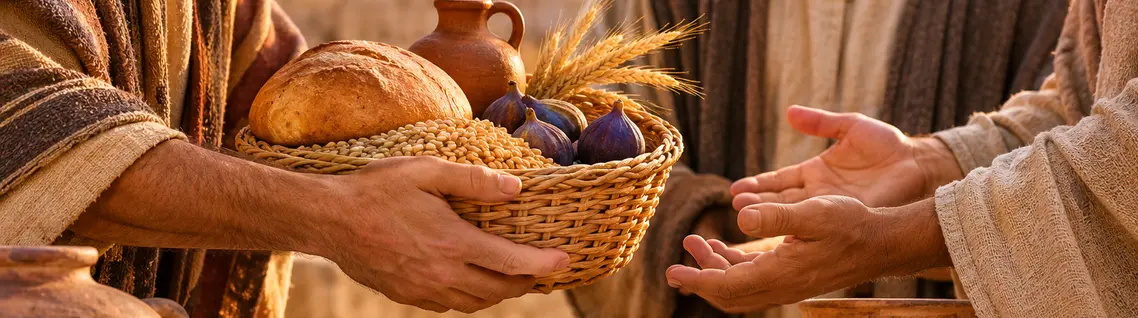
Leviticus 23:15-21 provides more detailed instructions. The Israelites were to count seven complete weeks from the beginning of the prescribed counting period. On the fiftieth day, they would present a new grain offering to the Lord. The celebration included two loaves of bread made from fine flour, together with additional sacrifices.
The presentation of firstfruits was more than a formal agricultural ceremony. It acknowledged that the harvest depended on God’s provision. Rather than treating the land and its produce as possessions independent of the Creator, Israel was instructed to recognize God’s authority and express gratitude through worship.
The instructions also connected the festival with communal responsibility. Leviticus 23:22, immediately following the festival regulations, reminds landowners not to harvest their fields completely, leaving portions for the poor and the foreign resident. This places gratitude to God alongside concern for vulnerable members of society.
The biblical instructions can be examined directly in Leviticus 23:15-21 in the King James Version.
Why was the festival celebrated after seven weeks and fifty days?
The calculation of Pentecost is based on counting seven complete weeks, which equal forty-nine days, followed by the fiftieth day. The instructions appear in Leviticus 23:15-16 and establish the festival’s relationship with the agricultural season that begins around the Passover period.
The counting expresses the passage from the beginning of the harvest cycle to its appointed celebration. It also explains why the Greek name Pentēkostē became associated with the festival: the name simply identifies the fiftieth day.
Christian Pentecost follows a related calculation. In the Western Christian calendar, it is celebrated on the fiftieth day counting Easter Sunday as the first day. Consequently, it falls seven weeks after Easter, traditionally described as fifty days after the resurrection celebration.
For Jewish communities, Shavuot remains a separate observance determined by the Jewish calendar. Its relationship with Passover is part of its own historical and religious framework, not simply a Christian calculation applied retrospectively.
The association between Shavuot and the giving of the Torah at Mount Sinai: biblical instructions and later Jewish tradition
One important distinction concerns the relationship between Shavuot and the giving of the Torah at Mount Sinai. The Torah establishes Shavuot as an agricultural festival and provides instructions for its observance. However, Leviticus 23 does not explicitly state that the festival commemorates the day Moses received the Law.
Exodus 19:1-19 records Israel’s arrival at Mount Sinai in the third month after leaving Egypt. The passage describes the preparation of the people for God’s revelation, accompanied by thunder, lightning, smoke, fire, and a powerful sound. These events provide an important biblical background for later associations between the festival and the revelation at Sinai.
The connection between Shavuot and the giving of the Torah developed within Jewish interpretive tradition. Early Jewish writings, including Jubilees, and later rabbinic literature reflect this association. It became an established part of Jewish understanding of the festival, although it should not be confused with an explicit command in the biblical festival regulations.
This distinction is important when comparing Jewish tradition with Acts 2. Both accounts can be read in relation to divine revelation and the presence of God, but one should not assume that every association developed in later Jewish tradition was necessarily part of the original festival’s meaning during every historical period. For further historical context, see the Posen Library’s study of Shavuot in Early Judaism.
How Does Luke Explain the Coming of the Holy Spirit at Pentecost?
Luke does not present the coming of the Holy Spirit as an unexplained supernatural occurrence. He places it within a larger narrative connecting Jesus’ ministry, resurrection, ascension, and the mission of his followers. This literary framework is essential for understanding the significance of Acts 2.
The historical and literary context of Acts and its connection to the Gospel of Luke
The Acts of the Apostles is closely connected to the Gospel of Luke. Both works are addressed to Theophilus, and Acts begins by referring to the earlier account of Jesus’ ministry. Luke 1:1-4 explains the author’s intention to provide an orderly account based on the testimony of those who witnessed the events.
The Gospel describes what Jesus began to do and teach, while Acts follows the continuation of his work through the apostles and the Christian community. The second book is not simply a collection of missionary stories. It develops a theological narrative showing how the message about Jesus moves outward from Jerusalem toward the wider world.
Within this structure, Pentecost marks a decisive turning point. The disciples who previously waited for the fulfillment of Jesus’ promise now receive the power needed to participate in the mission. The event provides the foundation for the public witness that dominates the remainder of Acts.
Jesus’ promise of the Holy Spirit and the mission to the ends of the earth (Luke 24:49; Acts 1:8)
Before his ascension, Jesus tells his disciples that they must remain in Jerusalem until they receive power from above. Luke 24:49 connects this instruction with the promise of the Father. Acts 1:8 develops the same idea by explaining what the coming of the Spirit will accomplish.
The Spirit’s purpose is directly connected to witness. The disciples are to proclaim what they have seen and heard about Jesus, beginning in Jerusalem and extending to increasingly distant regions. This geographical movement becomes the organizing framework of Acts.
The significance is that the disciples do not undertake this mission through personal ability or authority alone. They receive divine empowerment for a task that exceeds their original social and geographical circumstances. Pentecost is therefore the beginning of a new stage in the public proclamation of the gospel, not simply an experience intended for the private benefit of the gathered believers.
Peter’s interpretation of Joel 2:28-32 and the fulfillment of prophecy
Peter identifies Joel’s prophecy as the key to interpreting the outpouring of the Spirit. In its original prophetic context, Joel speaks about a future restoration in which God will pour out his Spirit broadly and bring about a remarkable transformation among his people.
One of the most significant features of the prophecy is its inclusive language. Sons and daughters, young and old, and male and female servants are included in the promise. The gift is not described as restricted to a small group of established religious authorities. God’s Spirit enables a wider community to participate in prophetic witness.
Peter’s use of Joel also introduces the language of the last days. The coming of the Spirit indicates that God’s promised action has entered a decisive stage through Jesus. However, this does not necessarily mean that every image in Joel’s description of the Day of the Lord was completed in the events of that single morning. Peter presents Pentecost as the beginning and visible evidence of the prophetic fulfillment.
The connection between Jesus’ resurrection, exaltation, and the outpouring of the Spirit (Acts 2:22-36)
Peter’s sermon moves beyond the signs that attracted attention in Jerusalem. He explains that Jesus was delivered up according to God’s purpose, crucified, and raised from the dead. The resurrection demonstrates that death did not have the final word over Jesus and confirms his identity within God’s redemptive plan.
Peter then uses Psalm 16:8-11 to explain why David’s words about being delivered from the grave cannot refer exclusively to David himself. David died and his tomb remained known, but Jesus was raised. Peter interprets the psalm in relation to the Messiah’s resurrection.
Psalm 110:1 provides the next part of his argument. Peter understands the reference to the Lord seated at God’s right hand as pointing to Jesus’ exaltation. This means that the outpouring of the Spirit is connected to the authority of the risen Christ. Pentecost is therefore not an independent event separate from the resurrection. It is presented as the consequence of Jesus’ victory and exaltation.
What Do Pentecost, Wind, Fire, and Tongues Mean in the Original Languages?
The original Greek terminology helps clarify several details in Acts 2. These words should not be treated as secret codes with hidden meanings. Their value is that they show how Luke describes the relationship between God’s Spirit, the signs accompanying his arrival, and the languages spoken by the disciples.
Pentēkostē and Shavuot: the Greek and Hebrew names for the festival
Pentēkostē (πεντηκοστή) is the Greek term meaning fiftieth. It reflects the calculation of seven weeks followed by the fiftieth day. The name became familiar in Christian language because Acts identifies the event as occurring on the day of Pentecost.
Shavuot (שָׁבוּעוֹת), meanwhile, is the Hebrew name meaning weeks. Both names refer to the same Jewish festival, but they emphasize different aspects of its calendar. Shavuot highlights the seven-week counting period, whereas Pentēkostē emphasizes the fiftieth day.
These names also clarify the historical relationship between Pentecost and Shavuot. Christianity did not create an entirely separate festival with the same calendar position. The Christian observance developed around the interpretation of an event that took place during an existing Jewish celebration.
Pneuma and pnoē: the relationship between Spirit, breath, and wind
Two Greek words help readers understand the imagery in Acts 2. Pneuma (πνεῦμα) can mean spirit, breath, or wind, depending on the context. It is the principal term used in the New Testament for the Holy Spirit. Pnoē (πνοή), used in Acts 2:2, refers to breath or wind.
The relationship between these words contributes to the literary effect of Luke’s description. A powerful sound resembling a rushing wind accompanies the arrival of the Spirit. The passage does not suggest that the Holy Spirit is merely natural air or a physical force. Instead, the windlike phenomenon functions as a sign accompanying God’s action.
This imagery also recalls the biblical association between breath and life. In Genesis 2:7, God gives life to the human being, and in other biblical passages wind and breath appear in descriptions of divine activity. Nevertheless, the precise meaning in Acts 2 must be determined by its immediate context: Luke is describing the arrival of the promised Holy Spirit.
Glōssa and dialektos: the meaning of tongue and language in Acts 2
Glōssa (γλῶσσα) literally refers to the tongue, the physical organ used for speech, and can also mean a language. In Acts 2:4, it is used to describe the languages in which the disciples begin speaking through the Spirit’s enabling.
Dialektos (διάλεκτος) refers to a language or dialect. Luke uses this term when describing how the listeners recognize the speech as belonging to their own linguistic communities. Acts 2:6 and 2:8 emphasize that individuals hear the message in the languages they know.
The combination of these terms strengthens the narrative’s emphasis on intelligible communication. The miracle is not merely that the disciples produce unfamiliar sounds. The listeners recognize the languages and understand the content. The purpose is to communicate the mighty works of God across linguistic boundaries.
The biblical imagery of fire and wind and the limits of symbolic interpretation
Fire and wind frequently appear in biblical descriptions of divine manifestations. At Sinai, God’s presence is accompanied by dramatic natural signs. Elsewhere, fire can communicate holiness, judgment, purification, or divine presence, while wind can symbolize God’s power and activity.
These associations help explain why Luke chooses such imagery for Pentecost. The signs communicate that something extraordinary has taken place and that the gathered believers have received the promised Spirit. They also allow readers to recognize similarities between the revelation at Sinai and the event in Jerusalem.
However, not every biblical image should be assigned every possible symbolic meaning. Luke explicitly connects the signs with the arrival of the Spirit, but he does not provide a separate explanation stating that each tongue of fire represents a particular gift or that the wind corresponds to one specific theological concept. Responsible interpretation recognizes the imagery without claiming more than the narrative establishes.
What Are the Main Interpretations and Misconceptions About Pentecost?
Although Christians broadly agree that Pentecost is a foundational event in the New Testament, some aspects of its interpretation remain debated. The differences concern the relationship between Acts and Paul’s teaching, the meaning of the Church’s beginning, and whether the spiritual gifts described in the New Testament continue in the same way today.
Is speaking in tongues in Acts 2 the same phenomenon described in 1 Corinthians 12-14?
Acts 2 describes the disciples speaking in languages that people from different regions recognize and understand. The emphasis is on communication across linguistic barriers. The listeners hear the mighty works of God in their own languages, making the event directly relevant to the international character of the gospel mission.
In 1 Corinthians 12-14, Paul addresses spiritual gifts within a local Christian congregation. Speaking in tongues is discussed alongside prophecy, interpretation, and other manifestations of the Spirit. Paul emphasizes that public worship must contribute to the understanding and building up of the community. He also explains that an utterance in a tongue requires interpretation when listeners cannot understand it.
Some Christians understand both accounts as manifestations of the same basic gift, with different purposes and circumstances. Others distinguish the recognizable human languages of Acts 2 from the form of tongues described in 1 Corinthians, where interpretation becomes especially important.
The shared Greek terminology does not automatically settle every question about the nature of the phenomenon. The immediate contexts are different, and the biblical authors emphasize different aspects of the experience. A careful reading should therefore avoid assuming that every description of speaking in tongues refers to an identical manifestation.
Was Pentecost the birth of the Church or the public inauguration of its mission?
Pentecost is frequently called the birthday of the Christian Church. This expression is understandable because Acts 2 describes the formation of a larger community centered on the apostles’ teaching, baptism, fellowship, and worship. The chapter shows the first major public expansion of the Christian movement after Jesus’ resurrection.
Nevertheless, the expression can be misleading if interpreted too literally. Jesus had already gathered disciples, appointed apostles, taught them, and established a community before Pentecost. Acts 1 even describes believers meeting in prayer and selecting Matthias to replace Judas.
For this reason, many interpreters describe Pentecost as the public inauguration or empowerment of the Church’s mission rather than the absolute beginning of every aspect of Christian community. The gathered disciples were already followers of Jesus; what changes is their empowerment and public witness through the Holy Spirit.
Pentecost and the Tower of Babel: literary parallels and interpretive limitations
Genesis 11:1-9 describes the Tower of Babel and the confusion of human languages. People who previously shared a common language become unable to understand one another, and they are scattered across the earth. Acts 2 presents a contrasting scene in which people speaking different languages hear the same message and recognize its meaning.
This difference has led many Christian interpreters to describe Pentecost as a reversal of Babel. The comparison can be useful as a theological illustration: where Babel emphasizes division and scattering, Pentecost displays the possibility of communication across existing differences through the Spirit.
However, the comparison has limitations. Luke does not explicitly cite Genesis 11 or identify Pentecost as the reversal of the Tower of Babel. Some scholars therefore question whether the connection was intended by the author or developed through later theological reflection. Furthermore, Pentecost does not eliminate linguistic diversity. People continue to speak different languages; what changes is their ability to hear and understand the message.
The strongest conclusion is that Pentecost demonstrates the gospel’s reach across linguistic and cultural boundaries. The Babel comparison may illuminate this feature, but it should remain an interpretive analogy rather than a direct statement attributed to Luke.
How different Christian traditions understand Pentecost and the gifts of the Spirit
Catholic, Orthodox, and Protestant traditions recognize Pentecost as a central event in the biblical account of the Church. They generally understand the coming of the Holy Spirit as essential to the Christian mission, although their explanations of the Spirit’s gifts and the Church’s ongoing experience differ.
Catholic and Orthodox traditions place particular emphasis on Pentecost as the manifestation of the Spirit in the Church and its continuing life. Their liturgical celebrations connect the event with the work of the Spirit in worship, sacramental life, and the mission of believers.
Within Protestant Christianity, there are also different theological positions. Pentecostal and charismatic movements generally emphasize the continuing activity of spiritual gifts, including healing, prophecy, and speaking in tongues. Many continuationists believe that the gifts described in the New Testament remain available to Christians today.
By contrast, cessationists argue that certain miraculous gifts, especially those associated with the foundational apostolic period, ceased or changed their function after the establishment of the Church. Other Christians adopt intermediate positions, recognizing contemporary spiritual gifts while disagreeing about their precise nature and purpose.
These differences should be distinguished from what Acts 2 explicitly describes. The passage clearly affirms the coming of the Spirit, the disciples’ Spirit-enabled speech, and the beginning of their public witness. It does not, by itself, resolve every later theological debate about how individual spiritual gifts should operate in the Church.
What does the biblical account actually affirm, and what conclusions should not be imposed on it?
Several conclusions can be established directly from the narrative. The Holy Spirit comes upon the gathered followers of Jesus, extraordinary signs accompany the event, the disciples speak in languages they had not previously learned, and people from different regions hear the proclamation of God’s mighty works. Peter interprets the event through Joel’s prophecy and connects it to the resurrection and exaltation of Jesus.
However, the passage does not establish every detail sometimes associated with popular descriptions of Pentecost. It does not explain that the signs must always appear in exactly the same physical form, that every Christian must reproduce the same manifestation, or that all later experiences of speaking in tongues are necessarily identical to the event in Jerusalem.
It is also important not to confuse the later Christian festival with the original Jewish celebration. Understanding the agricultural background of Shavuot and distinguishing later Jewish tradition from explicit biblical instructions prevents historical assumptions from being presented as direct statements of Scripture.
Exegesis requires allowing the passage to establish its own emphasis before drawing broader conclusions. In Acts 2, the central message concerns God’s fulfillment of his promise, the exaltation of Jesus, and the empowerment of his followers to proclaim the gospel.
What the Pentecost narrative means for Christian mission today as a consequence of its original meaning
The missionary significance of Pentecost follows directly from the narrative. The Spirit empowers the disciples to communicate the message of Jesus beyond their immediate cultural and linguistic environment. The event shows that the mission entrusted to the Church is not restricted to one people, geographical region, or language.
For Christians today, this principle has practical implications. Churches that serve people from different cultural backgrounds, for example, should recognize that making the gospel understandable is part of faithful communication. Language, translation, education, and attention to cultural differences can all contribute to sharing the message effectively.
The account also places Christ at the center of Christian mission. Peter does not use the experience to draw attention to the disciples themselves. He explains the signs by proclaiming Jesus’ resurrection, exaltation, and authority. The same emphasis should guide Christian witness today.
Ultimately, what is Pentecost within the larger biblical story? It is the moment when Jesus’ promise of the Spirit becomes a public reality and his followers receive power to participate in the mission that will extend beyond Jerusalem.
Conclusion: The Biblical Meaning of Pentecost
Pentecost connects the Jewish Feast of Weeks with a decisive event in the history of early Christianity. Originally an agricultural celebration associated with the wheat harvest and the presentation of firstfruits, Shavuot became the setting for the coming of the Holy Spirit described in Acts 2.
Luke presents the event through signs of wind and fire, Spirit-enabled languages, and Peter’s interpretation of Joel’s prophecy. The sermon explains that Jesus, who was crucified, has been raised and exalted by God, and that the outpouring of the Spirit confirms the fulfillment of his promise.
Rather than reducing Pentecost to a celebration of supernatural manifestations or simply labeling it the birthday of the Church, the biblical account points to something broader: the public empowerment of Jesus’ followers to proclaim the gospel. Its significance for Christians today follows from this original meaning, emphasizing the Spirit’s work and the Church’s responsibility to bear witness to Christ among all peoples.
Frequently Asked Questions
What is Pentecost and why is it important in the Bible?
Pentecost is the Christian celebration commemorating the coming of the Holy Spirit upon Jesus’ followers in Jerusalem, as described in Acts 2. It is important because it marks the fulfillment of Jesus’ promise and the empowerment of the disciples to proclaim the gospel. The event also connects Christian history with Shavuot, the Jewish Feast of Weeks.
Why is Pentecost celebrated 50 days after Easter?
The Christian date follows the biblical pattern of counting seven weeks and the fiftieth day associated with the Feast of Weeks. In the Christian calendar, Easter Sunday is counted as the first day, making Pentecost the fiftieth day of the Easter season. This also reflects the historical setting of Acts 2, when the Holy Spirit came during the Jewish festival of Shavuot.
What is the difference between Pentecost and Shavuot?
Shavuot is the Jewish Feast of Weeks, an agricultural festival associated with the wheat harvest and the offering of firstfruits. Pentecost is the Greek name for this same festival, meaning fiftieth. In Christian tradition, Pentecost additionally refers to the coming of the Holy Spirit upon the disciples in Acts 2 and the inauguration of their public mission.
What were the tongues of fire and the speaking in other languages in Acts 2?
The tongues resembling fire were visible signs accompanying the coming of the Holy Spirit. The speaking in other languages was the Spirit-enabled ability of the disciples to proclaim God’s mighty works in languages understood by people from different regions. The narrative emphasizes communication across linguistic boundaries rather than unintelligible speech.
Is Pentecost really the birthday of the Christian Church?
Pentecost is traditionally called the birthday of the Church because Acts 2 describes the public formation and expansion of the Christian community after Jesus’ resurrection. However, Jesus’ followers already existed as a community before this event. More precisely, Pentecost marks the public empowerment and inauguration of the Church’s mission through the Holy Spirit.
What did the coming of the Holy Spirit at Pentecost mean for the early Christians?
It meant that Jesus’ promise had been fulfilled and that his followers had received divine empowerment to proclaim the gospel. The Spirit enabled them to speak to people from different linguistic backgrounds, while Peter explained the event through the prophetic Scriptures and the resurrection of Jesus. The result was the growth of the early Christian community and the beginning of its expanding mission.
Continue deepening your understanding of biblical interpretation with Tower of Babel Meaning: What Genesis 11 Really Says and How to Study the Bible: A Guide to Accurate Interpretation and Reliable Resources. Explore these studies on Agapath to discover more about the historical context, literary meaning, and theological message of Scripture. To learn about revival movements in church history, read The 20 Greatest Revivals in History: When Jesus’s Promise in John 14:12 Came to Life.