The parable of the prodigal son is one of the best-known teachings of Jesus, but its meaning goes far beyond the story of a young man who wastes his inheritance and eventually returns home. Recorded in Luke 15:11-32, this narrative presents a father and two sons whose different responses reveal important truths about God’s mercy, human repentance, forgiveness, and reconciliation.
The younger son abandons his family, spends everything he receives, and eventually finds himself in desperate poverty. When he decides to return, his father welcomes him with compassion and organizes a celebration. Yet the older brother becomes angry and refuses to participate. His reaction introduces a second question: why would someone who has remained faithful to the household struggle to celebrate the restoration of another person?
Understanding what Jesus teaches requires more than reading the younger son’s story in isolation. The historical setting, Jewish inheritance customs, the original Greek expressions, and the position of the older brother all contribute to the interpretation. This study examines Luke 15:11-32 in its literary and cultural context to explain what the narrative meant to its first listeners and what it communicates to Christian readers today.
What Happens in the Parable of the Prodigal Son? A Close Reading of Luke 15:11-32
Jesus begins by describing a family with a father and two sons. The younger son initiates the conflict by requesting his inheritance and leaving home. The older brother remains on the family property, but his reaction to the younger son’s return reveals that physical proximity does not necessarily mean relational closeness.
The story develops through five movements, each contributing to its central message.
The division of the inheritance and the younger son’s departure (verses 11-13)
The younger son approaches his father and asks for the share of the property that will eventually belong to him. His request is significant because the father is still alive. Although ancient Jewish families could make arrangements to distribute property during a parent’s lifetime, asking for an inheritance in this way could communicate a serious rejection of family responsibilities.
The father agrees and divides his property between both sons. Luke does not explain the precise financial arrangement or describe an argument between the family members. After receiving his portion, the younger son gathers his belongings and travels to a distant country.
His decision represents more than a desire to explore another place. He separates himself from his father’s household and the relationships connected with it. He wants access to the family resources without continuing to participate in the family environment from which those resources came.
The narrative does not reveal everything about his motives. Nevertheless, the sequence of events establishes that his departure creates a significant rupture, which becomes the foundation for the conflicts that follow.
The waste of the inheritance and the son’s humiliation (verses 13-16)
In the distant country, the younger son spends his inheritance through reckless living. Luke does not provide a detailed description of his expenses. The essential point is that he uses his resources irresponsibly until nothing remains.
When a severe famine strikes the region, the young man finds himself without financial security. He accepts employment from a local resident, who sends him to the fields to feed pigs. For Jewish listeners, this occupation would have carried particular significance because pigs were classified as unclean animals under the dietary regulations of Israel.
Leviticus 11:7 and Deuteronomy 14:8 identify the pig as an animal that the Israelites were not permitted to eat. The younger son’s association with these animals therefore emphasizes the extent of his humiliation from the perspective of a Jewish audience.
His hunger becomes so severe that he longs to eat the pods given to the pigs. Yet no one provides him with food. The contrast is striking: he once possessed enough property to leave his father’s household, but now struggles to obtain even basic nourishment.
Jesus does not mention the names of the people involved in his financial decline or identify specific immoral activities. The text simply describes reckless living and the resulting loss of his resources. Its emphasis is on the consequences of abandoning the security of the household and wasting what had been entrusted to him.
The younger son comes to his senses and decides to return (verses 17-20a)
In his desperate situation, the younger son begins to think about his father’s household. He remembers that even the hired workers have enough food, while he is suffering from hunger. This comparison leads him to recognize that returning home offers a possibility of survival that he does not have in the distant country.
He prepares a confession. He intends to acknowledge that he has sinned against heaven and against his father and that he is no longer worthy to be called a son. He also plans to ask for a position as one of his father’s hired workers.
This speech reveals an awareness of personal responsibility. The young man does not simply blame the famine or the circumstances of the distant country. He recognizes that his own decisions contributed to his condition.
At the same time, Luke presents material necessity as the immediate motivation for his reflection. The story does not give readers complete access to his inner thoughts, so it would be inaccurate to claim that every aspect of his repentance is explained in detail.
He gets up and returns home. The decision is important because his recognition of failure leads to an actual change in direction. The narrative now shifts its attention to the father’s response, which becomes the emotional and theological center of the scene.
The father’s welcome and the restoration of his son (verses 20b-24)
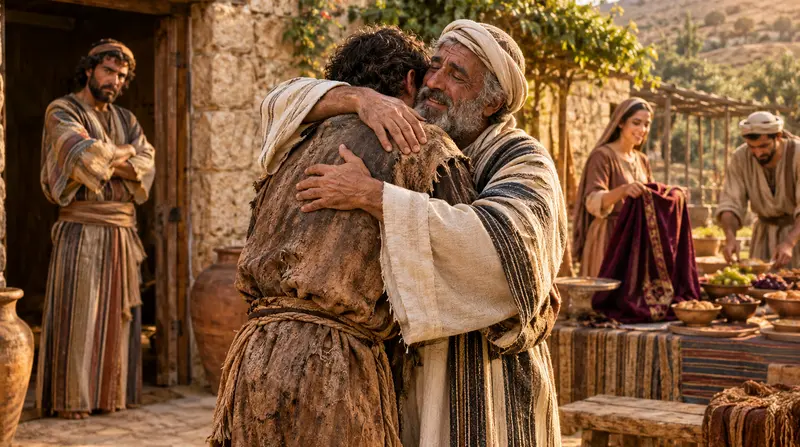
While the younger son is still far away, his father sees him, feels compassion, and runs toward him. He embraces and kisses his son before the young man can complete his prepared confession.
The father then orders the servants to bring the best robe, place a ring on his son’s finger, and put sandals on his feet. He also instructs them to prepare the fattened calf for a celebration.
These actions communicate more than the willingness to provide food and shelter. The father publicly welcomes the young man into the household. Instead of treating him simply as a worker who has returned seeking employment, he receives him as a member of the family.
There is also a significant detail in the son’s confession. In verse 19, he had planned to ask his father to make him one of the hired workers. In verse 21, however, his recorded confession ends with the acknowledgment that he is unworthy to be called a son. Luke does not explain whether the father interrupts him or whether the young man deliberately leaves out the final request.
The father explains the celebration through the images of death and renewed life: his son was lost and has been found. These expressions describe the seriousness of the separation and the significance of the restored relationship.
The celebration is therefore not primarily about recovering financial resources. The inheritance has already been spent. What the father celebrates is the return of someone he considers part of his family.
The older brother’s reaction and the father’s response (verses 25-32)
While the younger son is celebrating, the older brother returns from the fields. He hears music and dancing and asks a servant what is happening. When he learns that his brother has returned and that their father has prepared a feast, he becomes angry and refuses to enter.
The father goes outside to speak with him. Unlike his younger brother, the older son does not complain about poverty or the loss of property. His complaint concerns perceived unfairness. He argues that he has served his father for many years, obeyed his commands, and never received a similar celebration with his friends.
His resentment becomes evident in the way he speaks about his brother. He refers to him as his father’s son rather than identifying him as his own brother. He also emphasizes the younger man’s past failures, accusing him of wasting the family property with prostitutes. Interestingly, Luke’s earlier narration describes reckless living but does not independently mention prostitutes; this accusation comes from the older brother’s speech.
The father responds affectionately. He reminds the older son that he has always been with him and that everything belonging to the father is also his. Nevertheless, he insists that celebrating the younger son’s return is appropriate because someone who was lost has been found.
The story ends without revealing the older brother’s decision. This is not an insignificant detail. The unresolved ending directs the reader’s attention toward the question that motivated Jesus’ teaching: will those who consider themselves faithful accept the restoration of people they regard as sinners?
Why Did Jesus Tell the Parable of the Prodigal Son? The Context of Luke 15
Tax collectors and sinners draw near to Jesus while Pharisees and scribes criticize him (Luke 15:1-2)
The opening verses of Luke 15 provide the setting for the entire chapter. Tax collectors and sinners are approaching Jesus to listen to him. The Pharisees and scribes respond critically, complaining that he welcomes these people and eats with them.
Tax collectors were associated with the collection of revenue under Roman authority. Their work often placed them under suspicion among their fellow Jews, particularly because of concerns about collaboration with Roman administration and the possibility of financial exploitation.
The word sinners is a broader social and religious designation. It refers to people regarded as living outside accepted standards of religious conduct or whose reputations made them objects of criticism.
The controversy is therefore about more than conversation. Jesus’ willingness to receive these individuals demonstrates a form of fellowship that his critics find unacceptable. His response through the three parables explains why the recovery of people who were lost should produce joy rather than resentment.
Why Jesus welcoming sinners and eating with them caused controversy: the social and religious significance of shared meals in first-century Judaism
In first-century Jewish society, meals carried important social meaning. Sharing food could communicate hospitality, friendship, recognition, and participation in a relationship. Consequently, eating with people considered religiously or socially objectionable could raise questions about boundaries and appropriate conduct.
The Pharisees and scribes criticize Jesus because they believe his behavior is inconsistent with the standards expected of a religious teacher. They question why he associates so openly with people whose lives or reputations they consider unacceptable.
Jesus responds by presenting God’s concern for those who are lost. The shepherd searches for the missing sheep, the woman carefully looks for her lost coin, and the father welcomes his returning son.
These stories do not suggest that wrongdoing is insignificant. The younger son acknowledges his sin, and the preceding parables explicitly connect restoration with repentance. The point is that a person’s previous failures do not automatically eliminate the possibility of being welcomed and restored.
In this setting, the father’s reception of his son becomes an explanation of Jesus’ own willingness to receive sinners. The narrative challenges the assumption that maintaining religious boundaries must require rejecting everyone who has failed morally.
How the three parables of Luke 15 belong together: the lost sheep, the lost coin, and the lost son
Luke 15 contains three related parables. In the first, a shepherd searches for one missing sheep among a hundred. In the second, a woman searches carefully for one lost coin. In the third, a father receives a son who has abandoned his household.
The first two stories conclude with celebration over what has been recovered. Jesus connects this joy with the heavenly response to a sinner who repents. The third story develops the same theme but introduces more complicated questions about human responsibility and family relationships.
The sheep and the coin cannot consciously decide to return. The younger son, however, recognizes his condition and chooses to go home. Meanwhile, the father takes the initiative to welcome him and restore the relationship.
The older brother adds another dimension that is absent from the first two stories. While the shepherd and the woman rejoice over what they have recovered, the older son refuses to celebrate his brother’s return.
All three parables therefore address the same central issue: the recovery of what was lost should be a reason for joy. The final story also asks whether people who consider themselves faithful are willing to share that joy.
The parable within the Gospel of Luke: Jesus’ original audience, Luke’s intended readership, and the Gospel’s themes of mercy, reversal, and joy
The Gospel of Luke frequently emphasizes divine mercy, hospitality, the reversal of social expectations, and God’s concern for people who are marginalized. The parable fits naturally within these themes and appears in the broader narrative of Jesus’ journey toward Jerusalem.
Christian tradition identifies Luke as the author of the Gospel. Its opening verses address Theophilus and describe the purpose of presenting an orderly account of events concerning Jesus. The precise identity, social composition, and circumstances of the wider readership remain subjects of scholarly discussion.
It is important to distinguish Jesus’ original listeners from the later readers of Luke’s written account. The first audience heard the parable in a setting where Jesus was being criticized for welcoming sinners. Later readers encounter the same teaching as part of Luke’s presentation of Jesus’ ministry and the character of God’s kingdom.
The story also reflects Luke’s recurring interest in joy and restoration. The father’s celebration is not a minor conclusion to a family story. It expresses the response that Jesus expects when someone who was lost is recovered.
The Yale Bible Study resource on Luke’s lost-and-found parables provides further discussion of this literary context and helps readers consider the relationship between the three stories.
What Does the Historical and Cultural Background Reveal About the Parable?
Inheritance practices in Jewish society: the firstborn’s double portion in Deuteronomy 21:17 and the significance of an early division of family property
Jewish inheritance law established a double portion for the firstborn son. Deuteronomy 21:17 describes this as a recognition of his position within the family. In a household with two sons, the older son would ordinarily receive two shares of the inheritance, while the younger son would receive one.
This background helps explain the importance of the younger son’s request. He is asking for property that would normally be transferred after his father’s death. Although the distribution of an estate during a father’s lifetime was possible, the circumstances and timing made such a request socially sensitive.
The Jewish wisdom text Sirach 33:19-23 also warns against surrendering control of one’s possessions to family members while still alive. Sirach is included in Catholic and Orthodox biblical traditions, although it is not part of the Protestant Old Testament canon. Its advice provides useful evidence of concerns surrounding property and family responsibility in ancient Jewish thought.
Nevertheless, Luke does not state the precise amounts each son receives or describe a formal inheritance contract. The passage simply says that the father divided his property between them. The legal background should illuminate the story without introducing details that the narrative itself does not provide.
For the biblical foundation of the firstborn’s double portion, see Deuteronomy 21:17 in the King James Version.
Honor and shame in first-century society: family bonds, public reputation, and the communal consequences of the younger son’s departure
Honor and shame were important social categories in the ancient Mediterranean world. Family reputation was often connected to the behavior of individual members, particularly when their actions affected inheritance, household responsibilities, and public relationships.
The younger son’s departure communicates a serious break with the family. He receives his portion of the property and leaves, choosing independence rather than remaining within the household. His subsequent financial collapse makes the consequences of his decision even more visible.
The older brother’s refusal to enter the celebration also creates a public family conflict. The father’s joy over the returning son does not automatically resolve the resentment of the other child. Both actions demonstrate that family relationships have been damaged in different ways.
Some interpreters suggest that the father’s public welcome represents a willingness to bear social embarrassment in order to restore his son. This interpretation can illuminate the scene, although specific claims about exactly how all first-century fathers were expected to behave should be treated cautiously.
The distant country and the pigs: separation from the Jewish community and the dietary purity regulations of Leviticus 11:7 and Deuteronomy 14:8
Luke never names the distant country or identifies a specific location. The expression emphasizes the physical and relational distance between the younger son and his father’s household. It may suggest that he has entered a predominantly non-Jewish environment, but the text does not provide enough information to establish this with certainty.
The presence of pigs is more explicit. Under the dietary regulations of Israel, pigs were classified as unclean animals. This detail would have made the young man’s employment especially humiliating for Jewish listeners familiar with the Torah.
The passage does not explicitly state that the son has completely abandoned his religious identity. Rather, the image of feeding pigs reinforces how far he has fallen from the life he previously enjoyed.
The contrast with the father’s household is particularly important. Even the hired workers have enough food, while the younger son is unable to obtain adequate nourishment. This difference becomes the basis of his decision to return.
The carob pods and the feeding of pigs: famine, hunger, and the reversal of the younger son’s social position
The pods mentioned in the narrative are commonly identified as carob pods, the fruit of the carob tree. They could be used as animal feed and were also known as a food resource. Luke describes the young man longing to eat the food provided to the pigs, showing how extreme his hunger has become.
The image intensifies the reversal of his circumstances. He once possessed substantial resources and could decide how to use them. Now he cannot even guarantee his next meal.
The carob pods do not need to represent a separate spiritual symbol. Their narrative function is to demonstrate the depth of his material deprivation and help explain why returning to his father’s household becomes an attractive possibility.
The father running toward his son: ancient expectations concerning paternal dignity and authority, and the unexpected initiative of welcome
The father has authority over the household and its property, yet he responds to the returning son with compassion rather than an immediate demand for an explanation. He runs toward the young man, embraces him, and kisses him.
In a society where age, status, and public dignity were important, this action would have been striking. Jesus portrays a father who takes the initiative to restore a damaged relationship rather than waiting for his son to negotiate his position.
Some interpretations emphasize the unusual nature of a patriarch running toward someone who has dishonored the family. Others caution that ancient customs should not be reduced to a single universal rule about how fathers behaved. Luke’s primary emphasis is not a detailed description of social etiquette.
The father expresses compassion through action. He does not remain distant or require the young man to establish his worth before receiving him. His response makes the possibility of reconciliation visible.
The robe, ring, sandals, and fatted calf: signs of recognition, restored dignity, family belonging, and communal celebration, distinguishing textual evidence from later symbolic interpretations
The father orders the servants to bring the best robe, place a ring on the returning son’s finger, and put sandals on his feet. These items accompany the young man’s public reception into the household and communicate recognition and restored dignity.
The robe is associated with honor and welcome. The ring may indicate status or recognition within the family, while the sandals complete the presentation of the son as someone received into the household. These interpretations fit the narrative, but Luke does not assign a separate doctrinal meaning to each item.
The fattened calf makes the celebration especially significant. Preparing such an animal for a meal indicates a special occasion rather than an ordinary household gathering. The father wants the entire household to participate in the joy of his son’s return.
The father’s own explanation establishes the meaning of the event: his son was lost and has been found. The most reliable interpretation therefore emphasizes renewed family belonging and communal celebration instead of treating the objects as a collection of hidden theological codes.
What Do the Original Greek Words Reveal About the Meaning of the Parable?
The Gospel of Luke was written in Greek, and certain expressions clarify how the story describes inheritance, waste, reflection, compassion, and family relationships. These terms are most helpful when understood in their immediate literary context rather than assigned meanings that go beyond the evidence.
Ousia and bios: the distinction between property, inheritance, and livelihood in the father’s division of the estate
Two Greek words appear in the account of the inheritance. The first is ousia (οὐσία), which refers to property, an estate, or possessions. It appears in the younger son’s request for his share and again when Luke describes the resources he later wastes.
The second term is bios (βίος), which can refer to life, livelihood, or the resources by which someone lives. Luke uses it when describing the father’s division of his means between the two sons.
The distinction is useful because it connects the inheritance with the resources that sustain the family’s life. However, the words should not be forced into an elaborate theological opposition. Their function in the passage is primarily to describe the father’s property and the younger son’s inheritance.
Asotos and diaskorpizo: reckless living and the description of the younger son’s wasteful behavior
In Luke 15:13, the adverb asotos (ἀσώτως) describes the younger son’s way of living. It communicates the idea of reckless, extravagant, or wasteful conduct. The expression characterizes his behavior after leaving home.
The verb diaskorpizo (διασκορπίζω) means to scatter, disperse, or squander. Luke uses it to describe the loss of the young man’s property. Rather than preserving the resources he received, he dissipates them through irresponsible decisions.
Together, these words explain the financial aspect of his downfall. Jesus does not need to provide a detailed list of purchases or activities. The Greek expressions already establish that the young man wastes what he was given.
Eis heauton elthon: the meaning of coming to one’s senses and its relationship to recognizing one’s condition and repentance
In Luke 15:17, the expression eis heauton elthon (εἰς ἑαυτὸν ἐλθών) is commonly translated as coming to oneself or coming to one’s senses. It describes the moment when the younger son recognizes the reality of his condition.
His reflection produces a practical decision. He compares his hunger with the food available to his father’s hired workers and concludes that returning home is preferable to remaining in his present situation.
This expression should not be treated as a technical definition of Christian repentance. Its immediate meaning concerns recognition and reflection, followed by a decision to return. The confession of sin that follows develops the theme further.
Esplanchnisthe: the depth of the father’s compassion when he sees his returning son
The Greek form esplanchnisthe (ἐσπλαγχνίσθη), used in Luke 15:20, communicates compassion. It describes the father’s reaction when he sees his son approaching from a distance.
The significance becomes clearer when the verb is connected with the actions that follow. The father runs toward the young man, embraces him, and kisses him. His compassion is therefore expressed through a concrete response rather than remaining an internal feeling.
Related language appears in Luke 10:33, where the Samaritan sees the injured traveler and responds with compassion. In both narratives, compassion leads to action toward someone in need. This connection helps illustrate how mercy functions within Luke’s Gospel.
Hamartano, nekros, and anazao: the son’s confession of sin and the imagery of death and renewed life
The Greek verb hamartano (ἁμαρτάνω) means to sin or commit wrongdoing. It appears in the younger son’s confession, where he acknowledges that he has sinned against heaven and his father. His words demonstrate that he accepts responsibility for his actions rather than blaming the circumstances alone.
The father later describes the return through imagery of death and life. Nekros (νεκρός) means dead, while anazao (ἀναζάω) expresses the idea of living again or returning to life. These words describe the restoration of someone whose relationship with the family had been severely damaged.
The vocabulary of apollymi (ἀπόλλυμι), associated with losing, perishing, or being lost, also contributes to the chapter’s recurring theme. The lost sheep, the lost coin, and the lost son are all recovered, and each recovery produces joy.
Jesus is not suggesting that the younger son was physically dead. The language communicates the seriousness of his separation and the importance of being restored to the family relationship.
Douleuo: the contrast between serving as a slave and living as a son in the older brother’s speech
In Luke 15:29, the older brother describes his service to his father using the Greek verb douleuo (δουλεύω), which is associated with serving or being enslaved. His description emphasizes years of labor and obedience.
This is significant because he is not speaking simply as a son who has remained in his father’s household. He describes their relationship primarily through service, commands, and expected rewards. His language reveals the resentment that has developed within him.
The father does not deny his older son’s work or question his presence in the household. Instead, he reminds him that they have always been together and that everything belonging to the father is also his. The problem is the older brother’s inability to share in the celebration of another person’s restoration.
What Is the Central Message of the Parable of the Prodigal Son? The Two Sons, the Father, and Major Interpretations
Why the traditional title may be incomplete: the prodigal son, the lost son, the two sons, or the merciful father
The traditional title, the Prodigal Son, emphasizes the younger son’s wasteful behavior. In English, the word prodigal describes someone who spends resources extravagantly or recklessly. It is an appropriate title for the young man, but it does not necessarily capture the entire focus of the story.
Other interpreters prefer titles such as the Parable of the Two Sons, the Parable of the Lost Son, or the Parable of the Merciful Father. Each draws attention to a different aspect of the narrative.
The father is particularly important because he responds to both children. He welcomes the younger son and then leaves the celebration to speak with the older one. His actions connect the two parts of the story and reveal the central importance of mercy.
The title Parable of the Prodigal Son remains familiar and useful, but readers should remember that the narrative is about the entire family and not exclusively about the younger son’s failure.
Does the father represent God? Traditional Christian interpretation and the limits of excessive allegorical readings
Many Christian interpreters understand the father as a representation of God, whose mercy welcomes sinners and makes restoration possible. This interpretation fits the immediate context of Luke 15, where Jesus explains his willingness to receive people who have been regarded as sinners.
The two preceding parables reinforce this understanding. The shepherd searches for the missing sheep, and the woman searches for the lost coin. Both stories connect recovery with joy, providing a natural background for interpreting the father’s welcome as an illustration of divine mercy.
However, interpreters differ in how closely they identify every character and object with a specific theological reality. Some traditional readings use the story almost allegorically, while other approaches emphasize its narrative structure and social context.
An allegorical interpretation can become excessive when it assigns an independent doctrinal meaning to every object. For example, the text does not explicitly state that the ring represents a particular spiritual gift or that the sandals symbolize a specific stage of salvation.
A more reliable approach recognizes the broader correspondence between the father and God’s mercy while allowing the story to communicate through its own narrative details.
Trevor J. Burke’s scholarly article, The Parable of the Prodigal Father, explores the importance of the father’s extravagant generosity and considers why the traditional title may place too much emphasis on the younger son alone.
Was the younger son genuinely repentant? The distinction between recognizing personal misery, confessing sin, and fully understanding reconciliation
The younger son’s repentance raises an important interpretive question. His first reflection begins with physical hunger. He recognizes that his father’s workers have enough bread, whereas he is struggling to survive.
Nevertheless, his response goes beyond seeking food. He plans to confess his wrongdoing and acknowledge that he is unworthy to remain in his previous position. When he returns, he openly admits that he has sinned against heaven and his father.
Some interpreters understand this sequence as genuine repentance expressed through recognition, confession, and a decision to return. Others emphasize that Luke does not provide a detailed description of the young man’s inner transformation and that his original motivation is partly practical.
These observations should not be confused. Material necessity does not automatically make a confession insincere. At the same time, the story should not be forced into a complete theological description of every stage of repentance.
What can be affirmed from the narrative is that the young man recognizes his failure, takes responsibility, returns home, and receives his father’s welcome. These actions form the basis for understanding the relationship between repentance and mercy in the story.
Who does the older brother represent? His relationship to the Pharisees and scribes and the danger of turning the parable into a blanket condemnation of Judaism
The older brother’s resentment closely parallels the criticism that introduces Luke 15. The Pharisees and scribes object to Jesus welcoming sinners, while the older brother objects to his father’s celebration of the returning son.
This connection is supported by the literary context, but it should not become a generalized condemnation of Judaism. The Pharisees were a diverse Jewish movement, and the Gospels describe different interactions between Jesus and individual Pharisees.
The older brother represents a particular attitude within the story: the refusal to rejoice when someone considered undeserving receives mercy. He appears to have remained obedient and responsible, but his reaction reveals that he struggles to accept his father’s generosity toward another person.
The criticism is therefore directed toward self-righteousness and resistance to reconciliation, not toward every Jewish person or every form of religious commitment.
Were both sons lost? The younger son’s physical departure and the older son’s relational and spiritual distance
The younger son is clearly lost in the sense that he leaves home, wastes his inheritance, and becomes separated from his family. His physical distance reflects a damaged relationship with his father and brother.
The older brother remains on the family property, but his reaction reveals another form of separation. He is unwilling to enter the celebration and refuses to acknowledge the returning son as his brother. Although he has remained physically close to his father, he has developed resentment toward the father’s generosity.
The father approaches both sons. He runs toward the younger one and later goes outside to speak with the older one. This parallel is important because it shows that both children need to respond to the father’s invitation to reconciliation.
The narrative therefore challenges a simple division between an obviously rebellious person and an unquestionably faithful one. External obedience and physical proximity do not automatically produce a willingness to share in mercy.
Why does the parable end without revealing the older brother’s decision? The open ending as an invitation to Jesus’ original audience and subsequent readers
One of the most striking literary features of the story is its unresolved ending. The father explains why the celebration is necessary, but the reader never learns whether the older brother accepts the invitation and enters the house.
This incomplete resolution directs attention toward Jesus’ first listeners. The Pharisees and scribes had complained about his association with sinners. Now they are confronted with a story in which a father’s generosity is celebrated while another son refuses to participate.
The open ending invites the original audience to decide how they will respond. Will they recognize the restoration of sinners as a reason for joy, or will they continue to measure others according to their previous failures?
The same question remains relevant to subsequent readers. Instead of receiving a final statement about the older brother’s decision, they must consider their own response to the possibility that someone they regard as undeserving might receive mercy.
The National Catholic Education Commission’s commentary on Luke 15:11-32 also highlights this unresolved ending and explains how the older brother’s missing response contributes to the structure of the narrative.
What the parable actually teaches about grace, forgiveness, repentance, restoration, and communal reconciliation
The story presents mercy as an essential part of restoration. The younger son recognizes his wrongdoing and returns, but the father does not reduce their relationship to an employment agreement. He receives him as a son and celebrates his return.
Grace does not mean that the younger son’s actions were harmless. His irresponsible behavior, the loss of his inheritance, and his separation from the family remain important parts of the narrative. Mercy means that these failures do not have to determine the final outcome of his relationship with his father.
Forgiveness also has a communal dimension. The father does not simply provide a private welcome. He calls for a celebration involving the household, making the restoration visible to everyone. The return of the younger son becomes an event that challenges the attitudes of those around him.
The older brother demonstrates that reconciliation can be difficult for someone who believes another person has received more generosity than they deserve. The father therefore addresses both sons: one needs to return, while the other needs to accept the possibility of restored fellowship.
The central teaching is that God’s mercy welcomes those who are lost and challenges those who resist the restoration of others. The story brings together repentance, forgiveness, grace, and the responsibility to participate in reconciliation.
What the parable means for readers today: welcoming others, practicing mercy, and resisting exclusion as consequences of the text’s original meaning
For contemporary Christians, the story encourages careful reflection on how people respond when someone acknowledges wrongdoing and seeks to rebuild a damaged relationship. The father’s welcome does not erase the younger son’s past, but it refuses to make that past the only factor determining his future.
Imagine a family in which someone has been absent for years and eventually returns seeking reconciliation. Other relatives may remember previous harm and struggle to welcome the person. The narrative encourages openness to restoration while recognizing that trust and healthy relationships may require responsibility, time, and appropriate boundaries.
The older brother also challenges the tendency to compare another person’s opportunity for restoration with one’s own record of obedience. A person may fulfill responsibilities faithfully while still developing resentment toward someone who receives compassion.
This does not mean that forgiveness requires ignoring abuse, removing necessary safeguards, or excusing harmful behavior. Jesus’ parable addresses a family reunion and the welcome of a returning son. It does not provide a detailed rule for every situation involving violence, manipulation, or ongoing danger.
The practical implication follows from the original context: people who recognize the importance of God’s mercy must also consider whether they are willing to welcome the restoration of others.
Ultimately, the parable presents two sons who must respond to the same father. The younger son must return after recognizing his failure. The older brother must reconsider his resentment and accept that his brother’s restoration is a reason for celebration.
When we read the parable of the prodigal son in the context of Luke 15, we see that Jesus is addressing more than individual repentance. He is also challenging the attitudes that prevent people from sharing the joy of forgiveness and reconciliation. The father’s generosity is the central thread connecting both sons and the entire narrative.
Read Luke 15:1-32 in the King James Version in its entirety to observe how the lost sheep, the lost coin, and the two sons develop the same theme. Pay particular attention to the criticism in the opening verses and the unresolved conversation at the end, because these details reveal why Jesus told the story.
Frequently Asked Questions
Where is the Parable of the Prodigal Son found in the Bible?
The parable is recorded in Luke 15:11-32 in the New Testament. It is the third story in a sequence that also includes the lost sheep and the lost coin. Its immediate context begins in Luke 15:1-2, where Jesus responds to the criticism of Pharisees and scribes who object to his welcoming tax collectors and sinners.
Why did the younger son ask his father for his inheritance before his death?
Luke does not explain the younger son’s precise psychological motivation. His request allows him to receive his expected portion of the family property and leave the household. The decision represents a serious break with family relationships because he chooses to separate himself from his father’s household while taking the resources associated with it.
Why did the father run to meet his returning son?
The father’s actions demonstrate compassion and a willingness to restore the damaged relationship. Rather than waiting for the young man to reach the house and negotiate a position as a hired worker, he runs toward him, embraces him, and welcomes him. His response communicates that the son’s return is a reason for celebration rather than rejection.
What do the robe, ring, sandals, and fatted calf represent?
They communicate welcome, recognition, restored dignity, and celebration. The robe, ring, and sandals accompany the son’s reception into the household, while the fatted calf is prepared for a special feast. Although Christian interpreters have suggested additional symbolic meanings, Luke does not provide a separate doctrinal explanation for each object.
Who does the older brother represent in the Parable of the Prodigal Son?
Within the story, he represents someone who remains close to the household but resents the restoration of another person. His attitude parallels the Pharisees and scribes who criticize Jesus for welcoming sinners in Luke 15:1-2. However, he should not be treated as a representation of every Jewish person or religious leader. His role is to expose the difficulty of accepting mercy when it is extended to someone considered undeserving.
Was the Prodigal Son genuinely repentant before returning home?
The text shows that he recognizes his desperate situation, decides to return, and prepares a confession acknowledging his sin. His initial motivation includes material need, but he also accepts responsibility for his actions. Luke does not describe every detail of his inner transformation, so readers should distinguish what the narrative explicitly states from later theological conclusions about the stages of repentance.
Continue exploring forgiveness and biblical interpretation through Agapath’s studies, including How to Forgive Someone According to the Bible: Letting Go Without Denying the Hurt and How to Study the Bible: A Guide to Accurate Interpretation and Reliable Resources. Both articles offer further insight into the biblical principles of reconciliation and the careful interpretation of Scripture.