The search for the Michael name meaning in the Bible reveals more than the origin of a popular biblical name. Michael comes from the Hebrew name מִיכָאֵל (Mikha’el), traditionally translated as “Who is like God?” It appears in Scripture both as the name of several Israelites and as the designation of a powerful heavenly figure associated with the protection of God’s people. However, understanding Michael requires examining more than its translation. The book of Daniel describes his role in spiritual conflicts, Jude refers to his dispute with Satan, and Revelation portrays him leading angels against the dragon. These passages also raise an important theological question: Is Michael a created angel, or is he another designation for Jesus Christ? Exploring the original language, biblical context, and different Christian interpretations helps distinguish what Scripture explicitly says from what later theological traditions have concluded.
What Does the Michael Name Meaning in the Bible Tell Us About Its Hebrew Origin?
The Hebrew origin of Mikha’el (מִיכָאֵל) and its linguistic components
The name Michael originates from the Hebrew מִיכָאֵל (Mikha’el). Its traditional meaning is “Who is like God?” The name combines three linguistic elements that communicate this question:
- Mi (מִי): the Hebrew interrogative pronoun meaning “who?”
- Kə (כְּ): a comparative element meaning “like” or “as.”
- El (אֵל): a Hebrew designation for God.
When these elements are combined, they form a question that emphasizes God’s incomparable nature. The name is therefore not a statement that someone resembles God. Instead, it asks who could possibly be equal or comparable to Him.
The element El also appears in several other biblical names. Daniel, for example, incorporates the same divine designation, while Gabriel is another familiar name containing this element. Such names are called theophoric names, meaning that they incorporate a reference to God or a divine attribute.
The Hebrew name was also transmitted into Greek as Μιχαήλ (Michael), the form found in the Septuagint and the New Testament. Its pronunciation and spelling developed across different languages, but its traditional meaning remained recognizable.
Understanding the Hebrew etymology is essential because it establishes the foundation for interpreting Michael’s biblical identity. The name communicates a theological question rather than assigning divine characteristics to its bearer.
Why does “Who is like God?” express a rhetorical question rather than a claim of divine likeness?
A rhetorical question is a question asked to emphasize a point rather than to obtain information. In the case of Michael, the expected answer is that nobody can be compared with God in His divine nature, authority, and sovereignty.
This distinction matters because the expression is sometimes misunderstood as meaning “one who is like God.” That translation changes the grammatical emphasis and can create confusion about the biblical significance of the name.
The same theological idea appears in the Old Testament. In Exodus 15:11, the Song of Moses celebrates God’s victory over the Egyptian forces following Israel’s deliverance from slavery. The question about who is like the Lord among the gods is part of a song praising His holiness, power, and incomparable deeds.
Similarly, Micah 7:18 uses a question about who is like God to emphasize His unique character, particularly His willingness to forgive and show mercy. In both passages, the question communicates something about God’s nature rather than suggesting that another being shares His position.
For this reason, Michael’s name should not be interpreted as a declaration of equality with God. Its rhetorical structure communicates the opposite: every creature, including the highest heavenly beings, remains subject to the Creator.
How the meaning of Michael reflects the biblical affirmation of God’s uniqueness and sovereignty
The biblical understanding of God’s uniqueness provides an important background for interpreting Michael. Throughout Scripture, Israel is called to recognize that no human ruler, nation, idol, or spiritual power can occupy the place that belongs to the Lord.
This conviction does not mean that the Bible denies the existence of angels or other heavenly beings. Rather, it distinguishes the Creator from His creation. Angels may receive important responsibilities, deliver messages, and participate in events described in prophetic visions, but they do not possess God’s ultimate authority.
The name Michael fits naturally within this understanding. Even when associated with a powerful heavenly prince, it directs attention away from the creature and toward the God whose sovereignty cannot be challenged.
Was Michael in the Bible Always an Angel?
The Israelites named Michael in Numbers, Chronicles, and Ezra
Although Michael is widely recognized because of the archangel described in biblical passages, the name also belonged to several human individuals in ancient Israel. These references demonstrate that Michael was an established Hebrew personal name rather than a designation reserved exclusively for a heavenly being.
One early occurrence appears in Numbers 13:13. Michael is identified as the father of Sethur, the representative of the tribe of Asher among the twelve men sent by Moses to explore Canaan. This reference appears in the context of Israel’s wilderness journey and the mission to examine the land promised to the people.
Other individuals named Michael appear in genealogical passages:
- 1 Chronicles 5:13-14: Michael appears among the descendants of Gad, in a list of family heads.
- 1 Chronicles 7:3: Michael is named among the sons of Izrahiah from the tribe of Issachar.
- 1 Chronicles 8:16: Michael appears among the descendants of Beriah from the tribe of Benjamin.
- 2 Chronicles 21:2: Michael is listed among the sons of King Jehoshaphat.
- Ezra 8:8: Michael is identified as the father of Zebadiah, who belonged to the descendants of Shephatiah during the period of the return from exile.
These references serve different genealogical purposes. Some identify family members, while others help establish tribal ancestry and the relationships between prominent Israelite households.
They do not suggest that these individuals possessed supernatural abilities or shared the identity of the heavenly Michael. Their names were simply part of the broader use of Hebrew personal names that incorporated references to God.
The difference between the human individuals named Michael and the heavenly figure in Daniel
The distinction between human individuals named Michael and the heavenly figure becomes clear when each passage is examined in context. In Numbers, Chronicles, and Ezra, the name appears in genealogies and historical lists. In Daniel, however, Michael participates in visions involving heavenly conflict, foreign kingdoms, and the future of God’s covenant people.
The same principle applies to other biblical names. Several individuals can share a name without having the same identity, position, or responsibilities. Recognizing this prevents readers from combining unrelated biblical characters into one person.
Consequently, when someone asks who Michael is in the Bible, the answer depends partly on the passage being examined. The Old Testament contains several human individuals with this name, while Daniel introduces a distinct heavenly figure whose role becomes clearer in later biblical references.
Who Is Michael in the Bible’s Main Passages?
Michael in Daniel 10:13, 20-21: one of the chief princes and the protector of Israel
The most detailed early description of Michael as a heavenly figure appears in Daniel 10. The chapter begins by identifying the historical setting as the third year of Cyrus, king of Persia. Daniel receives a troubling revelation about the future of his people and spends three weeks mourning and abstaining from certain foods.
After this period, a heavenly messenger appears and explains that his journey to reach Daniel had been delayed by opposition from the prince of the Persian kingdom. The conflict lasted 21 days until Michael, described as one of the chief princes, came to assist him.
This description presents Michael as a figure with considerable authority in the heavenly realm. The expression “one of the chief princes” is particularly significant because it places him among the leading heavenly authorities rather than presenting him as an ordinary messenger.
Daniel 10:21 further identifies Michael as the prince associated with Daniel’s people. This connection suggests a special protective responsibility toward Israel. His involvement is not presented as an independent struggle against God or as evidence that he possesses divine sovereignty.
The passage instead reveals a relationship between historical events and an unseen spiritual dimension. The struggles experienced by earthly kingdoms are portrayed alongside conflicts involving heavenly powers. Michael’s participation therefore serves the broader purpose of demonstrating God’s continuing concern for His people.
Read the complete passage in Daniel 10:13-21 in the King James Version to understand the relationship between Michael, the heavenly messenger, and the prince of Persia.
The historical and literary context of Daniel: Persia, Greece, and the unseen spiritual conflict
The book of Daniel combines historical narratives with prophetic visions. Chapters 1–6 describe the experiences of Daniel and his companions serving under foreign rulers, while chapters 7–12 contain apocalyptic visions concerning kingdoms, persecution, judgment, and God’s ultimate victory.
Apocalyptic literature is a biblical and ancient Jewish literary genre that uses visions, symbolic imagery, heavenly messengers, and representations of political powers to reveal realities beyond ordinary human observation.
In Daniel 10, the prince of Persia appears alongside the prince of Greece. These figures are commonly interpreted as spiritual powers associated with the kingdoms they represent. However, the precise identity of these princes has been debated. Some scholarly approaches emphasize the close relationship between earthly political authorities and heavenly powers in the vision rather than treating the two dimensions as entirely separate.
The reference to Persia reflects the political environment surrounding the Jewish community after the Babylonian exile. Cyrus had conquered Babylon and permitted displaced peoples, including the Jews, to return to their homelands. Yet political permission did not mean that the restoration of Jerusalem and its institutions would be immediate or uncomplicated.
The mention of Greece also points toward the changing political powers that would affect the region. Daniel’s later visions describe conflicts involving the Greek kingdoms that emerged after Alexander the Great. Within historical-critical scholarship, these descriptions are frequently connected to the persecution of Jews under Antiochus IV Epiphanes during the second century BC.
There is also an important difference between traditional and critical approaches to the book’s composition. The traditional understanding places Daniel and his visions in the sixth-century BC exile. Many historical-critical scholars, meanwhile, consider the final form of the apocalyptic visions to have emerged during the Maccabean crisis, around 167–164 BC, while recognizing that some traditions within the book may be older.
These different approaches affect how readers understand the historical setting, but both recognize the central theological message: earthly empires do not possess ultimate control over history. For a broader academic introduction to these questions, consult the Oxford Research Encyclopedia of Religion entry on the Book of Daniel.
Michael in Daniel 12:1: the great prince who stands up during a time of distress
Daniel 12 continues the prophetic revelation and describes an unprecedented period of distress for God’s people. In this setting, Michael is identified as the great prince who stands up on behalf of Daniel’s people.
The expression describes a figure who takes action in defense of Israel during a moment of extraordinary difficulty. Michael’s role is therefore connected to the protection and deliverance of God’s covenant people, not to an independent power capable of determining their final destiny.
The following verses develop the message by introducing the hope of deliverance and resurrection. Daniel 12:2 speaks of those who sleep in the dust awakening, some to everlasting life and others to shame and contempt. This is particularly important because it connects the promise of protection with a wider biblical discussion about judgment and life beyond death.
In its literary context, Michael’s intervention belongs to a vision of divine justice. The message offers hope to a community facing suffering by affirming that oppression does not have the final word.
Michael in Jude 1:9: the dispute with Satan over Moses’ body and its connection to ancient Jewish tradition
The New Testament letter of Jude contains another important reference. In Jude 1:9, Michael is explicitly called the archangel and described as disputing with the devil over the body of Moses.
The unusual detail is that Michael does not pronounce a judgment against Satan on his own authority. Instead, he appeals to the Lord’s authority. This behavior contrasts with the arrogance of the people criticized throughout Jude’s letter, particularly those who reject authority and speak contemptuously about spiritual matters they do not understand.
The episode is not narrated in the Old Testament account of Moses’ death in Deuteronomy 34. Consequently, scholars have explored its relationship with ancient Jewish traditions concerning Moses and his death or departure from the earthly realm.
One proposed connection is the Assumption of Moses, an ancient Jewish work associated with traditions about Moses’ final destiny. However, the specific story mentioned in Jude has not been preserved in the surviving text, and its precise literary source remains uncertain.
Some scholarly interpretations suggest that the dispute concerned Moses’ bodily ascent into God’s presence rather than simply an argument over the location of his grave. Other explanations connect the episode with traditions about Satan’s accusation against Moses and the question of his worthiness. These proposals should be recognized as scholarly reconstructions rather than explicit statements in Jude.
There is also a possible literary connection with Zechariah 3:1-2, where Satan appears accusing the high priest Joshua and the Lord rebukes the accuser. In both accounts, the emphasis falls on divine authority rather than the personal power of the heavenly figure.
The central lesson of Jude 1:9 is therefore not a detailed account of the afterlife or the location of Moses’ body. It is the restraint demonstrated by Michael, who recognizes that judgment ultimately belongs to the Lord.
Read Jude 1:9 in the King James Version alongside the surrounding verses. For a deeper scholarly discussion of the Jewish background, see Ryan E. Stokes’s study, Not over Moses’ Dead Body: Jude 9, 22–24 and the Assumption of Moses in their Early Jewish Context.
Michael in Revelation 12:7-9: the heavenly battle against the dragon and the meaning of apocalyptic imagery
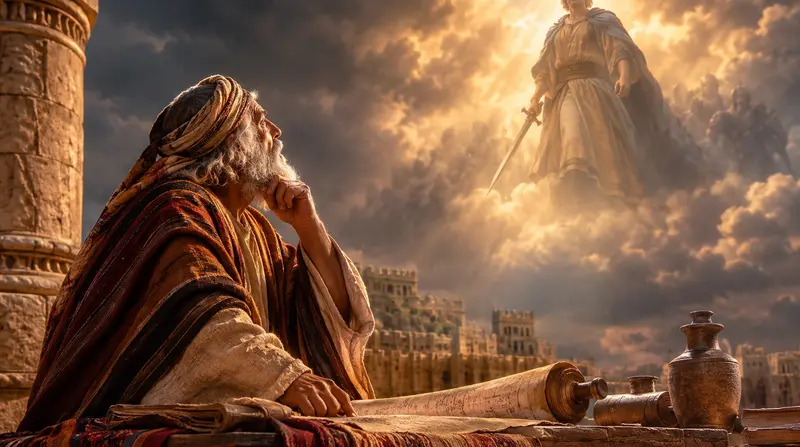
The book of Revelation presents Michael in a dramatic vision involving a woman, a male child, and a great dragon. Revelation 12:7-9 describes a battle in heaven in which Michael and his angels fight against the dragon and its angels. The dragon is explicitly identified with Satan, the devil, and the deceiver of the world.
This scene belongs to the apocalyptic message given through John to the seven churches of Asia. Its imagery communicates theological realities through symbols rather than presenting an ordinary historical narrative. The dragon represents opposition to God, while the defeat and expulsion of the dragon demonstrate the limits of evil in the face of divine authority.
The identity of every symbol in Revelation 12 has been interpreted in different ways. The woman, for example, has been associated with Israel, the people of God, and the community from which the Messiah comes. The child is commonly understood as the Messiah, particularly because the vision describes his destined rule over the nations.
Michael’s role is significant because he leads the heavenly forces against the dragon. Nevertheless, the chapter does not portray him as the ultimate source of salvation. The verses that follow connect the victory with the blood of the Lamb and the testimony of faithful believers.
Theological interpretation should therefore distinguish Michael’s participation in the heavenly battle from the central role of Christ in Revelation’s message. The ultimate victory belongs to God and His Messiah, while Michael serves within that divine purpose.
Consult Revelation 12:7-9 in the King James Version to examine the language of the battle and the identification of the dragon.
Is Michael an Angel or Jesus Christ?
What Scripture explicitly says about Michael as an archangel and heavenly prince
The clearest descriptions of Michael come from Daniel and Jude. Daniel identifies him as one of the chief princes and as the great prince associated with Israel. Jude 1:9 explicitly calls him an archangel.
The Greek term used in Jude is archangelos (ἀρχάγγελος), commonly understood as a chief or leading angel. The title communicates authority within the heavenly realm, although Scripture does not provide a complete organizational chart of angelic ranks.
It is worth noting that 1 Thessalonians 4:16 also uses the term archangel when describing the Lord Jesus’ return. Paul writes that the Lord will descend from heaven with a commanding call, the voice of an archangel, and the trumpet of God. However, Paul does not explicitly identify the archangel mentioned there as Michael.
These distinctions matter. The biblical text directly associates Michael with the title of archangel, but the question of whether he is identical to Christ requires additional theological interpretation.
Why some Christian traditions identify Michael with Christ: the arguments involving 1 Thessalonians 4:16 and Revelation 12
Some Christian traditions identify Michael with Jesus Christ in His heavenly role. This interpretation is particularly associated with the Seventh-day Adventist Church and Jehovah’s Witnesses, although the two groups understand the nature of Christ differently.
One argument comes from 1 Thessalonians 4:16. Because Paul describes Jesus returning with an archangel’s voice, some interpreters connect this passage with Jude 1:9, where Michael is called the archangel. They conclude that Michael and Jesus are two names associated with the same heavenly person.
Another argument comes from Revelation 12. Michael leads his angels against Satan, while other New Testament passages describe Jesus exercising authority over heavenly beings. Interpreters who identify the two figures see these descriptions as complementary portrayals of Christ’s heavenly leadership.
Seventh-day Adventists understand Michael as a title of Christ rather than as a created angel. Jehovah’s Witnesses also identify Jesus with Michael but have a different understanding of Christ’s nature and relationship to God. Their official explanation, for example, argues that Jesus is Michael in his heavenly existence.
These positions should be described accurately rather than combined into a single doctrine. Although both identify Michael with Jesus, their broader theological beliefs are not identical.
Why Catholic, Orthodox, and many Protestant interpretations distinguish Michael from Jesus, including the argument from Hebrews 1
Many Catholic, Eastern Orthodox, and Protestant interpretations distinguish Michael from Jesus. In this understanding, Michael is a created heavenly being who serves God, while Jesus Christ possesses a unique identity and status as the Son of God.
A major argument comes from Hebrews 1:4-14. The chapter presents the Son as superior to the angels and emphasizes that angelic beings serve within God’s purposes. This distinction supports the understanding that Christ cannot simply be placed within the same category as created heavenly servants.
Another argument concerns the wording of 1 Thessalonians 4:16. Paul says that Jesus descends with an archangel’s voice, but this expression does not necessarily identify Jesus as the archangel. A person can be described as accompanied by a particular voice or sound without being identical to its source.
Similarly, Revelation 12 describes Michael commanding angels, but leadership over heavenly forces does not automatically establish divine identity. Within this interpretation, Michael’s authority is delegated, whereas Christ occupies a unique position in God’s redemptive work.
The distinction is especially important when reading Hebrews. The chapter does not directly discuss Michael by name, but its broader argument establishes a theological framework for distinguishing Christ from angelic creatures.
What can be established from the biblical texts and what depends on later theological interpretation
Several conclusions can be established directly from Scripture:
- Michael is identified as one of the chief princes in Daniel 10:13.
- He is associated with the protection of Israel in Daniel 10:21 and 12:1.
- Jude 1:9 calls him an archangel and describes his dispute with Satan.
- Revelation 12:7-9 portrays him leading angels against the dragon.
However, the Bible does not explicitly state in a single verse that Michael and Jesus are the same person. Nor does it provide a complete explanation of every aspect of angelic hierarchy.
The identification of Michael with Christ therefore depends on how different Christian traditions connect the passages in Daniel, Jude, Revelation, and 1 Thessalonians. A careful interpretation recognizes the arguments while distinguishing direct biblical statements from theological conclusions drawn through comparison.
What Does the Name Michael Represent in Christian Tradition?
“Who is like God?” as a declaration of divine uniqueness and sovereignty
In Christian tradition, Michael’s name is commonly associated with the defense of God’s honor and sovereignty. This association is rooted in the Hebrew meaning and in the biblical descriptions of his role among the heavenly beings.
The question “Who is like God?” communicates that no human authority or spiritual power can replace the Creator. Even the highest heavenly servants remain dependent on Him and act within His purposes.
This understanding also provides a useful framework for interpreting the spiritual conflicts described in Daniel and Revelation. Michael’s importance does not come from independence or equality with God, but from his participation in the divine order.
The relationship between the original meaning, Michael’s biblical role, and Christian interpretations
The Hebrew meaning of Michael and the biblical character are related, but they should not be confused. Etymology explains the original significance of the name, while the biblical passages describe the actions and responsibilities associated with the heavenly figure.
Daniel emphasizes Michael’s connection with the protection of Israel. Jude highlights his restraint in a confrontation with Satan. Revelation presents his leadership in a heavenly battle. Each passage contributes a different aspect of the biblical portrait.
The Christian interpretation of Michael develops from reading these accounts together with broader teachings about angels, Christ, and God’s sovereignty. This is why different traditions can agree on the basic biblical references while disagreeing about the identity of the figure.
Ultimately, the Michael name meaning in the Bible should direct attention toward the central theological statement expressed by the Hebrew question: God has no equal. This remains true whether a Christian tradition understands Michael as a distinct angel or identifies him with Christ.
The difference between the biblical meaning of Michael and popular associations with personality, strength, and protection
Modern name guides frequently associate Michael with qualities such as courage, strength, leadership, protection, and determination. These associations are understandable given the biblical portrayal of Michael as a heavenly warrior, but they should not be mistaken for the actual meaning of the Hebrew name.
Scripture does not teach that every person named Michael will necessarily possess a particular personality or receive supernatural protection because of the name. A biblical name’s etymology does not establish someone’s character, destiny, or spiritual position.
For parents considering the name, its historical and biblical significance can still provide a meaningful reason for choosing it. Its original question points toward humility before God and recognition of His incomparable authority.
In conclusion, Michael comes from the Hebrew Mikha’el and means “Who is like God?” The name appears in the Old Testament both among human Israelites and in Daniel’s description of a heavenly prince. The New Testament develops this portrait through Jude’s reference to the archangel and Revelation’s account of the battle against Satan. Christian traditions differ over whether Michael is distinct from Jesus or another designation for Christ, but the biblical passages consistently place the discussion within the broader affirmation of God’s sovereignty. Understanding the original language and literary context makes it possible to appreciate the name without confusing biblical evidence with later interpretations.
Frequently Asked Questions
What does the name Michael mean in the Bible?
Michael comes from the Hebrew Mikha’el (מִיכָאֵל) and means “Who is like God?” The expression is a rhetorical question emphasizing God’s uniqueness and sovereignty. In Scripture, the name belongs to several human individuals and to the heavenly figure described in Daniel, Jude, and Revelation.
Does Michael mean “Who is like God?” or “One who is like God”?
The traditional Hebrew meaning is “Who is like God?” It is an interrogative expression rather than a statement of resemblance or equality. Its expected answer is that nobody can compare with God in His divine nature and authority.
Who is Archangel Michael and what is his role in the Bible?
Michael is a heavenly prince associated with the protection of Israel in Daniel. Jude identifies him as an archangel, while Revelation describes him leading angels against Satan. These passages portray him as an important heavenly figure who acts within God’s sovereignty.
Is Michael the Archangel the same person as Jesus Christ?
Christians hold different interpretations. Seventh-day Adventists and Jehovah’s Witnesses identify Michael with Jesus, although their beliefs about Christ’s nature differ. Catholic, Eastern Orthodox, and many Protestant traditions understand Michael as a created angel distinct from Jesus. The biblical passages do not explicitly resolve the question in a single statement.
Where does Michael appear in the Bible?
The main passages about the heavenly figure are Daniel 10:13, Daniel 10:20-21, Daniel 12:1, Jude 1:9, and Revelation 12:7-9. Other references identify human individuals named Michael in Numbers 13:13, 1 Chronicles 5:13-14, 1 Chronicles 7:3, 1 Chronicles 8:16, 2 Chronicles 21:2, and Ezra 8:8.
Is Michael mentioned in the Bible only as an angel, or were there also people named Michael?
No. Several human individuals in the Old Testament also bear the name Michael. Numbers identifies Michael as the father of Sethur, while Chronicles and Ezra mention other people with the same name in genealogies and historical records. These individuals are distinct from the heavenly figure in Daniel.
Continue exploring the origins and biblical significance of Scripture’s names through Biblical Boy Names and Meanings: Origins, Stories, and Bible References and Meaning of the Name David in the Bible: Hebrew Origin and Biblical Significance.