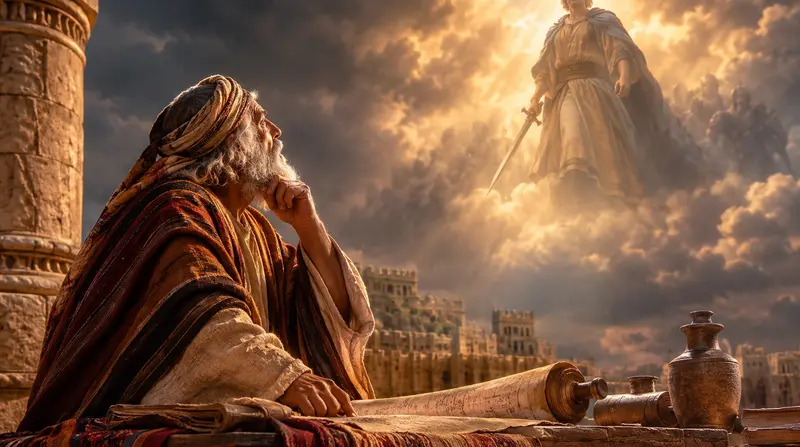
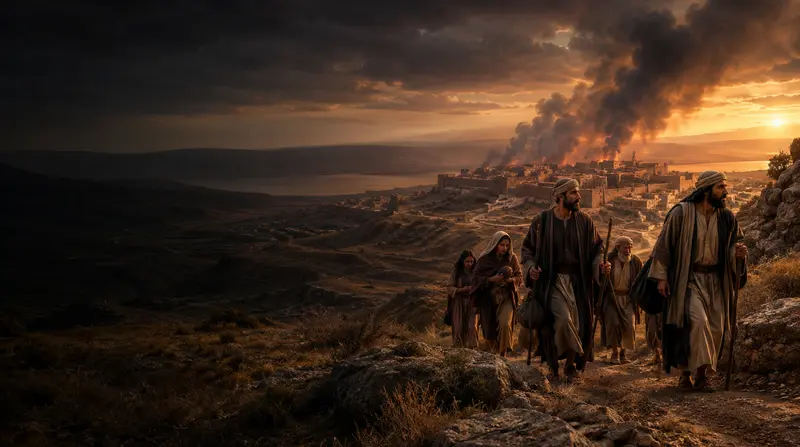
Sodom and Gomorrah in the Bible are remembered for a devastating judgment, but the story raises questions that cannot be answered responsibly by reading a single verse in isolation. Why did God destroy the cities? What were their inhabitants doing? Does Genesis focus primarily on sexual sin, violence against strangers, social injustice, or several forms of corruption together? And what can archaeology actually establish about the places described in the biblical account?
The narrative in Genesis 18–19 presents a city whose inhabitants commit serious acts of violence, an appeal for divine justice, Abraham’s intercession, and Lot’s escape before the destruction. Later biblical writers develop the story’s meaning in different ways. Ezekiel emphasizes pride and the neglect of the poor, while Jesus uses Sodom as a warning about judgment and human accountability.
This study examines the historical and literary setting, the Hebrew and Greek terminology relevant to interpretation, the major Christian perspectives on sexuality and hospitality, and the evidence surrounding proposed archaeological locations. The goal is not to force every question into a simplistic answer, but to distinguish what Scripture explicitly says, what interpreters infer, and what remains uncertain.
What Happened to Sodom and Gomorrah in the Bible?
Lot’s Choice and the Prosperous Jordan Valley in Genesis 13
The story begins before the destruction. In Genesis 13, Abraham and his nephew Lot possess large herds and substantial wealth. Their resources have grown to the point that the land cannot adequately support both households together, and disputes arise between their herdsmen. Abraham proposes that they separate peacefully and allows Lot to choose his destination first.
Lot looks toward the Jordan Valley and sees that it is well watered, resembling the garden of the Lord and the land of Egypt. He chooses the region and settles near Sodom. The narrator, however, adds a troubling observation: the inhabitants of Sodom are exceedingly wicked and sinful against the Lord.
This contrast establishes an important theme. The land appears attractive because of its fertility, but material prosperity does not guarantee moral integrity. The account does not teach that wealth itself is sinful. Rather, the description prepares readers for the difference between a promising landscape and the conduct of the people who inhabit it.
Lot’s choice is also part of the larger narrative about Abraham and his family. Abraham remains connected to the region through his concern for Lot, while Lot’s proximity to Sodom places him within a society that will soon become the focus of divine judgment.
Abraham’s Intercession and the Announcement of Judgment in Genesis 18
In Genesis 18, God announces that the outcry against Sodom and Gomorrah is great and that their sin is exceedingly serious. The narrative presents a judicial question: whether the reported wickedness warrants judgment and whether the righteous will be treated in the same way as the wicked.
Abraham responds by asking whether God would destroy the righteous together with the wicked. He begins with the possibility that fifty righteous people might be found in the city and then progressively reduces the number, eventually asking whether God would spare it if only ten righteous people were present.
Abraham’s argument appeals to the character of the divine Judge. He is not merely asking God to overlook wrongdoing. He is asking whether judgment can be carried out without treating the innocent and guilty as indistinguishable. The conversation therefore joins two themes that run throughout the passage: the seriousness of human corruption and the possibility of mercy.
God agrees that the city would be spared if the stated number of righteous people were found. This exchange does not present the judgment as an arbitrary decision unrelated to the condition of the inhabitants. Instead, it places the fate of the cities within a discussion of justice, accountability, and the possibility of divine restraint.
Read Genesis 18:20–33 in the King James Version to follow the full exchange. Abraham’s intercession is essential to understanding the narrative because it precedes the destruction and frames the question of whether judgment and mercy can coexist.
The Arrival of the Messengers and the Violence of Sodom’s Inhabitants in Genesis 19:1–11
Two messengers arrive in Sodom in the evening, and Lot meets them near the city gate. He urges them to stay at his home, provides shelter, and prepares a meal. His actions establish a contrast between the hospitality he offers and the hostility they encounter from the surrounding community.
Before the visitors retire for the night, the men of the city gather around Lot’s house. The narrative describes a crowd that includes both young and old inhabitants. They demand that Lot bring the visitors outside so that they can have sexual relations with them.
The context makes clear that this is not a request for a consensual relationship. The visitors are surrounded, threatened, and treated as people whom the crowd has the right to seize. The scene presents an attempted act of collective sexual violence, involving coercion and the humiliation of vulnerable strangers.
Lot leaves his house and attempts to restrain the crowd. In a deeply disturbing response, he offers his daughters to the men instead. The narrative records this proposal, but it does not establish it as an ethical model. Lot’s attempt to protect his guests comes at the expense of his daughters’ safety, exposing the moral disorder of the situation rather than resolving it in an admirable way.
The messengers intervene by pulling Lot back inside and striking the attackers with blindness. Even then, the men continue attempting to find the entrance. Their persistence emphasizes the seriousness of the threat and contributes to the narrative’s portrayal of a community resistant to restraint.
Hospitality is certainly important in this episode, but it is not an adequate explanation if it causes readers to overlook the sexual nature of the demand. The narrative explicitly portrays a threatened assault. Violence, hostility toward outsiders, abuse of power, and the violation of hospitality belong together in the scene.
Lot’s Escape, the Destruction of the Cities, and His Wife’s Fate
After the encounter, the messengers warn Lot that the city will be destroyed. He is instructed to gather the members of his household who can be taken away from the coming disaster. His prospective sons-in-law dismiss the warning, treating it as though Lot were joking.
As dawn approaches, the messengers urge Lot, his wife, and his two daughters to leave. Lot hesitates, and the visitors take the family by the hand and lead them outside. The narrator explicitly connects their deliverance with God’s mercy. Lot then asks permission to flee to a small nearby town, Zoar, rather than escape into the surrounding hills.
Genesis 19 describes fire and sulfur descending upon Sodom and Gomorrah and the destruction of the cities and their surrounding region. The language communicates a catastrophic reversal of the land’s earlier appearance as fertile and desirable. It presents the event as divine judgment, although it does not offer a modern scientific explanation of the physical process involved.
During the escape, Lot’s wife looks back and becomes a pillar of salt, according to Genesis 19:26. The text does not explain her psychological motivations in detail. Traditional interpretations often associate her action with disobedience or attachment to the life she was leaving, but readers should distinguish these inferences from what the narrative directly states.
Abraham later looks toward the region and sees smoke rising from the land. The account connects Lot’s preservation with God’s remembrance of Abraham, returning the reader to the intercession in the preceding chapter. The combined narrative of Genesis 18–19 brings together judgment, mercy, human violence, and the rescue of a vulnerable household.
Genesis 19 continues with the account of Lot and his daughters after their escape. That episode contains further morally difficult behavior. As elsewhere in biblical narrative, the recording of an action does not automatically make the action an example to follow or an ethical practice approved by the narrator.
What Was the Historical, Geographical, and Literary Context of the Story?
The Jordan Valley, the Valley of Siddim, and the Dead Sea
Genesis places the cities in the region of the Jordan plain, but it does not provide coordinates precise enough to identify their archaeological remains with certainty. Genesis 14 mentions the Valley of Siddim in an account of conflict among kings and associates it with pits of bitumen. These details reflect the geographical world of the narrative, but they do not settle the location of the cities in modern terms.
The Dead Sea has become a central landmark in attempts to locate the settlements. The surrounding region includes arid terrain, salt deposits, bitumen, and a complex geological history. These features make the area relevant to archaeological investigation, but proximity to the Dead Sea does not prove that a particular ancient settlement was Sodom or Gomorrah.
Geographical landscapes can also change over long periods through natural processes and human activity. A responsible reconstruction must compare the biblical descriptions with topographical evidence, archaeological findings, and the chronology of ancient settlements rather than assuming that every ancient geographical reference corresponds exactly to the modern landscape.
Hospitality and the Protection of Strangers in the Ancient Near East
Hospitality was an important social expectation in many ancient Near Eastern communities. Travelers often depended on others for shelter, food, and protection, particularly in places where safe lodging and reliable public security were limited. Receiving a guest could therefore involve a responsibility to protect that person from harm.
This background helps explain why Lot insists that the visitors stay in his home. His offer provides them with shelter and places them under his protection. The crowd’s attempt to remove them from that shelter is therefore a violation of expected hospitality as well as an act of personal aggression.
However, ancient hospitality should not be used as a way to minimize the narrative’s explicit sexual threat. The crowd does not simply reject the visitors or refuse to accommodate them. Its demand is coercive, and its behavior includes a clear intention to subject the strangers to sexual violence.
Scholars continue to examine the legal and cultural assumptions underlying the episode, including the relationship between hospitality, social status, and a host’s obligations. Such studies can illuminate the scene, but specific reconstructions of ancient customs should be presented as interpretations when the evidence does not establish them conclusively.
The Patriarchal Narratives of Genesis and the Literary Purpose of the Cities’ Destruction
Genesis 13–19 belongs to the larger collection of narratives about Abraham and his family, often called the patriarchal narratives. These chapters combine family relationships, journeys, conflicts, dialogues, and extraordinary events to develop themes about divine promises, human choices, justice, and preservation.
The story has a recognizable literary progression. Lot first chooses to settle near a prosperous region; Abraham then intercedes when judgment is announced; the behavior of the inhabitants reveals the gravity of the situation; and the destruction concludes the main conflict while preserving Lot and his daughters.
The contrast between Abraham and Lot is significant, although neither character should be treated as flawless. Abraham raises questions about justice and pleads for mercy. Lot offers protection to the visitors but later proposes exposing his daughters to danger. Their actions contribute to the narrative’s complexity rather than presenting a simple division between a completely righteous person and a completely wicked one.
The story of Sodom and Gomorrah in the Bible is not written as a modern archaeological report. Its literary form communicates theological convictions about the seriousness of injustice and the consequences of moral corruption. This does not, by itself, prove that the account has no historical basis; it means that historical reconstruction and literary interpretation are distinct tasks.
What the Bible Says About the Cities’ Location and What Remains Unknown
The biblical texts associate the cities with the Jordan plain and the broader Dead Sea region, but they do not provide a map identifying their ruins. Several archaeological sites have been proposed as candidates, and researchers disagree about how well their locations, dates, and material remains fit the biblical descriptions.
Genesis also mentions other cities in the region, including Admah and Zeboiim, while Zoar appears as the place where Lot seeks refuge. These references show that the tradition concerns a broader geographical setting, but they do not establish a universally agreed count of all settlements affected by the destruction.
The most responsible conclusion is that the biblical tradition provides a general geographical framework while leaving the precise location uncertain. A plausible geographical proposal is not the same as an archaeological identification demonstrated by converging evidence.
What Were the Sins of Sodom and Gomorrah According to Different Biblical Texts?
The Outcry Against the Cities and the Violence in Genesis 18–19
Genesis 18:20 uses the Hebrew word tse’aqah, which can mean an outcry or a cry. In this context, it communicates the seriousness of the situation and introduces the question of divine response. The passage does not provide a detailed list of every wrongdoing at this point; the events in the next chapter develop the moral picture through the behavior of the inhabitants.
Another important Hebrew term is yada, meaning “to know.” The verb has a broad range of uses in the Hebrew Bible and can refer to ordinary knowledge. In some contexts, it functions as a euphemism for sexual relations. In Genesis 19:5, its precise force must be evaluated within the scene, where the crowd surrounds a house and demands that its visitors be brought outside.
Many interpreters understand the demand as an attempted gang rape. This reading takes account of the threatening situation, the crowd’s coercive behavior, and the surrounding narrative. Whatever further cultural interpretations scholars may propose, the verb should not be isolated from the actions that define the scene.
The moral portrait therefore includes violence, hostility toward strangers, abuse of power, and contempt for human dignity. Sexuality is relevant to the discussion, but it should not become a reason to ignore the coercive character of the assault or the vulnerability of its intended victims.
Pride, Abundance, and Neglect of the Poor in Ezekiel 16:49–50
Ezekiel offers a complementary description of Sodom. In his prophetic comparison between Jerusalem, Samaria, and Sodom, he identifies pride, abundant food, comfortable security, and failure to help the poor and needy as features of Sodom’s wrongdoing. He then refers to further practices that he describes as abominable.
This passage matters because it names social sins that cannot be reduced to a single sexual category. Abundance is not condemned merely because a community possesses resources. The problem is a society that enjoys prosperity and security while neglecting people who need assistance. Comfort becomes morally corrupt when accompanied by pride and indifference to suffering.
The passage can be read in Ezekiel 16:49–50 in the King James Version. Within Ezekiel’s argument, the comparison is an accusation against Jerusalem: the city cannot condemn the failures of others while refusing to recognize its own injustice.
The Hebrew term to’evah, commonly translated as “abomination” or “detestable practice,” appears in this context. Its general meaning does not justify assigning every possible wrongdoing in the chapter to one behavior. The term must be interpreted in connection with the prophetic argument and the specific practices the passage describes.
Ezekiel therefore broadens the moral significance of the narrative. Sodom becomes a warning against pride, prosperity without compassion, and the neglect of vulnerable people. This is an explicit part of the biblical tradition and should not be overlooked when examining the city’s reputation.
Collective Sexual Violence and the Contextual Meaning of “Know” in Genesis 19:5
A consensual sexual relationship and a sexual assault are fundamentally different acts. In Genesis 19, the crowd does not propose a mutually agreed relationship with the visitors. The men surround the house, pressure Lot, and demand that the strangers be handed over. The context portrays a threat of coercive sexual violence rather than a consensual encounter.
This distinction changes how the central question should be framed. The narrative does not offer a modern classification of sexual orientation or describe a romantic relationship. It depicts a group attempting to overpower other people, using intimidation and numerical superiority as instruments of domination.
At the same time, the sexual nature of the threat should not be denied because violence and inhospitality are also central. These aspects can be connected: a collective sexual assault can violate bodily autonomy, humiliate outsiders, exploit unequal power, and reject the duty to protect a guest.
The verb yada has several uses, so its meaning cannot be determined mechanically from a dictionary entry. The crowd’s demand, Lot’s response, and the messengers’ intervention form the immediate context that guides interpretation. A sound reading considers the whole scene rather than allowing one lexical possibility to override the narrative evidence.
Fire, Sulfur, and the Biblical Language of Judgment in Genesis 19:24–25
Genesis describes the destruction with the Hebrew expression gofrith wa’esh, referring to sulfur and fire. The image conveys devastation and divine judgment, reinforcing the seriousness of the event in the story. It also contributes to the dramatic reversal of the landscape previously described as attractive and fertile.
The Hebrew verb haphak can carry the sense of turning, overturning, or transforming. In the narrative, the destruction radically changes the condition of the cities and their surroundings. This vocabulary belongs to the biblical portrayal of judgment; it is not a technical explanation of a geological process.
The references to fire and sulfur do not, by themselves, establish whether a physical event involved an earthquake, an ordinary fire, another natural disaster, or some other process. Such claims require evidence beyond the wording of the narrative. The theological meaning of the passage and the scientific investigation of a possible physical event address related but different questions.
Within Genesis, the central claim is that the wrongdoing of the cities brings judgment. The account presents violence and corruption as matters of moral consequence rather than treating them as harmless features of urban life.
How the Prophets Reuse Sodom as an Example of Injustice and Corruption
The story’s importance extends beyond Genesis. In Isaiah 1:9–10, Sodom and Gomorrah appear in a prophetic accusation against Judah. The comparison confronts the audience with its own moral condition, showing that familiarity with religious tradition does not exempt a community from accountability.
Jeremiah 23:14 likewise compares Jerusalem’s corruption with the wickedness associated with Sodom. This is not merely a historical reference. The prophet invokes the past to expose wrongdoing in his own community and to challenge those who mislead others through their conduct.
Deuteronomy 29:22–28 uses the ruined cities as an illustration of the consequences of covenant unfaithfulness. Amos 4:11 recalls destruction as a warning, while Zephaniah 2:9 uses the imagery of desolation. These passages have distinct immediate purposes, but all draw on the cities as examples of judgment.
The prophetic reception of Sodom therefore expands its significance. The story becomes a tool for criticizing injustice, arrogance, corruption, and unfaithfulness in later communities. An interpretation that concentrates on one issue alone risks missing the breadth of the biblical tradition.
Was the Sin of Sodom Homosexuality or a Violation of Hospitality?
Traditional Interpretations of Genesis 19 and Their Understanding of Sexuality
Many Jewish and Christian interpreters have understood Genesis 19 as part of the biblical condemnation of same-sex sexual practices. This reading takes the crowd’s sexual demand seriously and connects the episode with other passages that these traditions regard as relevant to sexual ethics, including Leviticus 18:22, Leviticus 20:13, and Romans 1.
Supporters of this interpretation argue that the sexual dimension of the scene should not be removed from the theological discussion. They maintain that Genesis must be read in conversation with the rest of Scripture rather than treated as an isolated passage.
However, there is an important distinction between interpreting the conduct depicted in Genesis 19 and claiming that the chapter offers a complete account of the sexual identities or relationships of every inhabitant of the city. The narrative describes a threatened act of collective violence against particular visitors, not a modern analysis of sexual orientation or same-sex relationships.
Even interpreters who retain a traditional view of Christian sexual ethics should acknowledge the coercive nature of the episode. An attempted sexual assault cannot simply be equated with a consensual relationship because both involve people of the same sex.
Why the Narrative Describes a Threat of Gang Rape Rather Than a Consensual Relationship
The crowd surrounds a home, demands that the visitors be brought outside, and rejects Lot’s attempt to protect them. There is no discussion of mutual agreement, affection, or commitment. Instead, the scene depicts a group threatening strangers who are in a vulnerable position.
Sexual violence can be used to establish dominance, humiliate people, and intimidate those who lack social power. In different historical settings, such violence has functioned as a means of coercion rather than as an expression of a mutually chosen relationship. This distinction helps explain the scene without reducing the violence to sexual desire alone.
Lot’s daughters must also remain part of the interpretation. When he offers them to the crowd, he places them in danger. The narrative should not be romanticized as though this proposal were a model of virtue, and historical customs should not be invoked to excuse the threat to their safety.
A responsible reading recognizes both the sexual nature of the demand and its violence against vulnerable strangers. Neither aspect should erase the other. The narrative’s condemnation of the crowd’s behavior is tied to coercion, hostility, and the abuse of power.
The Social and Ethical Perspective of Ezekiel 16:49–50 and Matthew 10:14–15
Ezekiel emphasizes pride, abundance, and indifference toward the poor. His description makes it impossible to reduce every biblical reference to Sodom to the sexual violence described in Genesis 19. The prophetic accusation addresses a society that enjoys security and resources without meeting its responsibility toward people in need.
Matthew 10:14–15 provides another perspective. Jesus instructs his disciples about what to do when a household or town refuses to receive them. In that setting, Sodom serves as a warning about the responsibility of those who reject the messengers. The comparison is part of a teaching about receiving their message and the seriousness of that response.
The connection between these passages is significant because they use the same tradition for different purposes. Genesis narrates violence and judgment; Ezekiel emphasizes pride and the neglect of the needy; Matthew applies the example to communities that reject Jesus’ messengers.
Hospitality and social justice are therefore not explanations invented outside Scripture. They are supported by biblical texts that explicitly recall Sodom. Nevertheless, those texts should not be used to claim that the sexual threat in Genesis is absent or that all Christian traditions draw the same conclusions about sexual ethics.
What Jude 7 Contributes to the Debate and the Meaning of “Different Flesh”
The letter of Jude refers to the cities as an example of judgment and associates their conduct with sexual immorality and the pursuit of different flesh. The Greek expression heteras sarkos can be translated as “other flesh” or “different flesh.” Its precise force in Jude’s argument remains a matter of debate.
One interpretation understands the expression as referring to sexual conduct considered immoral by the author. Another emphasizes the extraordinary nature of the visitors in Genesis, who are identified as heavenly messengers, and considers the attempted sexual encounter with beings of a different order relevant to the phrase.
Jude’s argument gathers examples of transgression and judgment, but it does not automatically resolve every modern question about sexuality. The connection with Genesis 19 matters, yet the interpretation depends on how readers understand the Greek phrase and the larger collection of examples in the letter.
The passage should therefore be taken seriously without presenting a debated interpretation as though it were universally accepted. Comparing Genesis, Jude, Ezekiel, and the Gospels helps readers recognize the different emphases within the biblical tradition.
What the Text States Directly, What Can Be Inferred, and Where Interpretations Differ
It is helpful to distinguish three levels of interpretation. The first concerns what the narrative directly describes: the inhabitants are portrayed as wicked, a crowd attempts to seize the visitors, a sexual threat is made, and the cities are judged. These details come from the story itself rather than from a modern theory about human behavior.
The second level involves interpretations of cultural conventions, linguistic details, and the characters’ motives. Scholars discuss the duties of hospitality, the function of sexual violence, social power, and the relationship between Genesis and later biblical interpretations. These proposals should be evaluated according to their evidence and their consistency with the text.
The third level concerns broader Christian sexual ethics. Conservative Christian traditions often connect Genesis 19 with other passages they regard as authoritative for sexual conduct. Other interpretations give greater weight to the scene’s coercion, violence, and hostility toward strangers and challenge the use of the account as a general condemnation of consensual same-sex relationships.
These differences should not be hidden, but neither should disagreement become an excuse to disregard the text. A responsible conclusion explains its reasoning, acknowledges the limits of individual arguments, and distinguishes a threatened assault from a consensual relationship. The wider biblical context matters, but it must be examined carefully rather than invoked selectively.
Did Sodom and Gomorrah Really Exist? What Can Archaeology Establish?
Major Proposed Locations Around the Dead Sea
Archaeologists investigate ancient places through physical remains, inscriptions, settlement patterns, dating evidence, and geographical relationships. In the case of the cities of the plain, no identification universally accepted by scholars conclusively establishes a known ruin as biblical Sodom or Gomorrah.
One group of proposals focuses on the southeastern area of the Dead Sea, where Bronze Age settlements have been discussed as possible candidates. Other theories place Sodom farther north or northeast of the Dead Sea. Each proposal must be evaluated against the biblical geographical references, the chronology of the site, and the archaeological evidence.
The biblical descriptions can guide historical investigation, but they cannot independently identify a settlement. A convincing proposal would require several kinds of evidence to converge: a plausible location, a suitable archaeological chronology, and material findings consistent with the historical reconstruction being proposed.
Bab edh-Dhra, Numeira, and Tall el-Hammam: Proposals, Evidence, and Limitations
Bab edh-Dhra and Numeira are archaeological sites southeast of the Dead Sea that have frequently appeared in discussions about the cities of the plain. Both contain evidence of ancient occupation and are valuable for understanding settlement in the region. Their archaeological remains, however, do not by themselves establish that either site was Sodom or Gomorrah.
Tall el-Hammam, northeast of the Dead Sea, became widely discussed after researchers proposed identifying it with Sodom and associated its destruction with a possible cosmic airburst. The hypothesis attracted considerable public attention because it appeared to connect a dramatic archaeological event with the biblical description of destruction.
The proposed identification has not become an archaeological consensus. Moreover, the widely publicized study advancing the airburst explanation was retracted by Scientific Reports in April 2025 following concerns about methodology, data analysis, and interpretation. That development reinforces the need to distinguish a published hypothesis from an established conclusion.
These sites remain relevant to the study of the region’s ancient settlements. Their exact relationship to the biblical narrative, however, remains uncertain. Archaeological claims should distinguish observations made at a site from the interpretation of those observations and from the further claim that the site corresponds to a named biblical city.
What Destruction Layers and Natural Disaster Hypotheses Can Explain
Archaeological evidence such as burned structures, collapsed buildings, ash deposits, and materials altered by intense heat can reveal that a settlement experienced destruction. Depending on the context, these findings can help researchers reconstruct events, establish a chronology, and assess whether conflict or natural processes may have contributed to a settlement’s decline.
Yet a destruction layer does not automatically reveal its cause. Different events can produce overlapping traces, and the interpretation depends on the distribution of the remains, geological conditions, dating methods, and comparison with other evidence. Even a dramatic event cannot be assigned a specific explanation merely because it resembles part of an ancient narrative.
There is also a separate question of identification. Even if a site experienced a catastrophic event consistent with some broad features of Genesis, researchers would still need evidence that it occupied the right location and belonged to the appropriate historical period.
Archaeology can provide evidence about settlements, environments, and material events. It cannot directly establish the divine intention described by a religious text. The theological reading of judgment and the scientific investigation of physical evidence can inform one another, but they operate through different methods.
Why Archaeologists Have Not Reached a Definitive Identification of the Biblical Cities
The absence of consensus does not mean that archaeological investigation is useless or that future discoveries cannot improve our understanding. It means that the currently available evidence does not establish a definitive identification. Researchers may agree about the date of a settlement while disagreeing about its relationship to a particular biblical place.
Another difficulty is the difference between the periods represented by archaeological remains and the stages through which biblical traditions were transmitted and composed. Dating a ruin cannot automatically establish when a narrative was written, nor does it prove that the narrative refers to that particular site.
Claims about Sodom and Gomorrah in the Bible should therefore be evaluated by separating geographical proposals, archaeological evidence, historical reconstruction, and theological interpretation. The most reliable approach is to compare the available evidence and describe uncertainty honestly rather than treating a popular theory as a settled discovery.
How Do Jesus and the New Testament Writers Reinterpret Sodom and Gomorrah?
Sodom as a Warning About Judgment and Accountability in Matthew 11:20–24
In Matthew 11:20–24, Jesus compares Sodom with towns that witnessed his works yet did not repent. The surrounding passage criticizes communities that received significant signs and teaching but failed to respond appropriately. The comparison emphasizes that receiving a message brings responsibility rather than automatic approval.
Jesus says that the judgment will be more tolerable for Sodom than for certain towns that rejected his works. His immediate purpose is not to provide a complete catalogue of Sodom’s sins. Rather, the city becomes a warning about accountability: the more clearly a community encounters a message, the more serious its refusal can become.
This use of the tradition differs from the detailed account in Genesis. Sodom functions as an example in a confrontation with Jesus’ own audience, challenging the assumption that familiarity with religious claims is sufficient. The passage should not be turned into a license to pronounce the final judgment of God upon particular individuals; its immediate function is to challenge the response of the communities addressed.
The Days of Lot in Luke 17:28–32 and the Urgency of Human Response
In Luke 17:28–32, Jesus recalls the days of Lot while teaching about the coming of the Son of Man. People were eating, drinking, buying, selling, planting, and building. Ordinary life continued until Lot left the city and destruction followed.
The point is not that eating, commerce, agriculture, or construction are inherently sinful. These are ordinary activities. Jesus’ emphasis is on the apparent normality of life in a setting where judgment arrives unexpectedly and on the need to respond to God rather than assuming that familiar routines guarantee safety.
Jesus then refers to Lot’s wife. Her story becomes a warning against turning back when escape is necessary. Within Luke’s teaching, the example concerns readiness and the urgency of responding to God. Its meaning should be interpreted in that larger argument rather than reduced to a speculation about the woman’s private thoughts.
Lot’s Example in 2 Peter 2:6–8 and Judgment Against Ungodliness
Second Peter 2:6–8 presents the destruction of the cities as an example of judgment against ungodliness. It also portrays Lot as distressed by the conduct he encountered around him. The passage supports the author’s broader argument that God can judge wrongdoing while delivering those who belong to him.
The immediate context concerns false teachers and people whose conduct harms others. The author uses earlier examples to warn readers against destructive behavior and to affirm that injustice has consequences. His purpose is not to investigate the geographical location of the ancient cities.
Lot’s portrayal also shows why the different texts should be read together without flattening their differences. In Genesis, Lot makes morally troubling decisions while living in a violent society. In 2 Peter, he is presented as distressed by the surrounding conduct. The later text emphasizes one aspect of his character without erasing the difficult actions recorded in the earlier narrative.
Sodom in Jude 7 and the Use of Earlier Traditions in Early Christian Literature
The letter of Jude invokes the cities as an example of judgment and refers to sexual immorality and the pursuit of different flesh. Its argument uses familiar biblical and Jewish traditions to warn its readers against practices the author considers incompatible with faithfulness to God.
This reference shows that the story continued to be interpreted in new contexts. Jude does not merely repeat the events of Genesis; the author incorporates an earlier tradition into a warning directed at a particular community facing its own problems.
The details of the Greek expression and its connection with Genesis 19 remain debated. Readers can recognize the relationship between the passages without claiming that all linguistic and theological questions have been resolved unanimously. Careful interpretation considers both the original narrative and the way later biblical writers use it.
What Does the Biblical Account Mean for Readers Today?
Justice, Violence, Pride, and Indifference Toward Vulnerable People
Reading Genesis alongside Ezekiel and the New Testament shows that the account is more than a story about an ancient catastrophe. Biblical writers use its memory to discuss violence, arrogance, moral responsibility, rejection of divine messengers, and the neglect of people who need protection.
A community may enjoy economic stability while tolerating abuse, protecting influential people, or ignoring those without power. Ezekiel’s emphasis on pride and neglect of the poor challenges the assumption that comfort and prosperity are reliable signs of moral health. Abundance becomes part of the problem when it coexists with indifference toward suffering.
Genesis 19 also requires readers to take sexual violence seriously. The visitors face a threat that cannot be minimized by turning the discussion into an abstract debate about morality. Their vulnerability and the coercive behavior of the crowd belong at the center of the interpretation.
Responsible Interpretation, Historical Context, and Contemporary Application
Applying the narrative responsibly begins with understanding what it meant in its own literary and historical setting. Genesis portrays a city marked by corruption and violence. Ezekiel uses Sodom to criticize pride and social neglect, while Jesus and other New Testament writers draw on the tradition to discuss judgment, accountability, and faithfulness.
This variety of uses is a reminder not to build an interpretation on an isolated phrase. It also requires care when applying modern categories to the ancient world. The narrator of Genesis does not use contemporary concepts of sexual identity or orientation, although later Christian discussions of sexual ethics may connect the narrative with other biblical passages.
Such discussions should be based on the relevant texts as a whole. An interpretation of Genesis 19 must distinguish the actions directly described, conclusions drawn from the cultural context, and theological arguments that depend on connections to other passages.
Historical and archaeological questions require similar care. Religious conviction need not turn a disputed archaeological proposal into historical certainty. Conversely, archaeological research can investigate material remains without directly proving or disproving the theological interpretation of a biblical story.
The Limits of Using Sodom as a Label for Groups or Individuals Without Considering the Biblical Context
Using the name of the city as an insult or automatically applying it to particular groups can obscure the complexity of the biblical texts. Genesis describes specific actions, while the prophets and New Testament writers use the tradition to address different moral and theological concerns.
The story should not be used to excuse sexual violence, justify mistreatment, or replace careful biblical study with indiscriminate accusations. The condemnation of violence, pride, and injustice remains significant even where readers disagree about the application of particular passages to contemporary sexual ethics.
Christian traditions also differ in how they connect Genesis 19 with other biblical teaching. Some retain a traditional sexual-ethical interpretation, while others emphasize coercion, inhospitality, and hostility toward strangers. A responsible discussion explains these differences fairly and evaluates the arguments rather than presenting one denominational conclusion as the only possible reading where genuine debate exists.
Conclusion: What Can We Say With Confidence About Sodom and Gomorrah?
The account of Sodom and Gomorrah describes a society whose corruption culminates in a violent threat against visitors and the judgment narrated in Genesis 19. The intercession of Abraham comes before the destruction, placing questions of justice and mercy at the center of the larger story.
Later biblical texts develop the moral significance of the episode in several directions. Ezekiel highlights pride, abundance, and neglect of the needy; the Gospels use Sodom as a warning about judgment and accountability; and Jude and 2 Peter invoke the tradition in discussions of ungodliness and its consequences. The full biblical picture therefore includes more than a single moral category.
The precise location of the cities remains uncertain. The Dead Sea region is central to many proposals, but the archaeological sites discussed in connection with the account have not been conclusively identified as the biblical cities. The evidence should be evaluated without confusing a disputed hypothesis with an established discovery.
Reading Sodom and Gomorrah in the Bible responsibly means paying attention to context, the violence described, the original language where it matters, and the way later biblical writers reuse the tradition. Rigorous interpretation does not require pretending that every question is settled. It requires distinguishing textual evidence from inference, acknowledging meaningful disagreements, and refusing to claim more certainty than the evidence supports.
Frequently Asked Questions About Sodom and Gomorrah
What was the real sin of Sodom and Gomorrah according to the Bible?
Genesis describes the inhabitants’ wickedness and a collective threat of sexual violence against foreign visitors. Ezekiel 16:49–50 adds pride, abundance without compassion, and neglect of the poor. Taken together, the biblical texts present a broad moral picture involving violence, injustice, arrogance, and, according to certain interpretations, sexual wrongdoing. The later references do not reduce the cities’ sins to one issue alone.
Where were Sodom and Gomorrah located, and is there archaeological evidence that they existed?
The biblical tradition places the cities in the region of the Jordan plain, associated with the Dead Sea. Bab edh-Dhra, Numeira, and Tall el-Hammam have all been discussed in connection with possible locations, but none has been conclusively and universally identified as the biblical cities. Archaeological remains establish ancient occupation in the region, but linking a particular site to Genesis requires additional evidence.
Why did God destroy Sodom and Gomorrah with fire and sulfur?
In Genesis, the destruction is presented as divine judgment against the cities’ grave wrongdoing. The surrounding narrative includes the announcement of judgment, Abraham’s intercession, and the threatened assault against the visitors. Fire and sulfur convey the devastation described by the text, but Genesis does not provide a modern scientific explanation of the physical mechanism involved.
Was homosexuality the only sin of Sodom and Gomorrah?
Genesis 19 describes a threat of collective sexual violence, not a consensual relationship between people of the same sex. Some Christian traditions connect the episode with other biblical passages to support a broader sexual-ethical interpretation. Other readings emphasize violence, abuse of power, and the violation of hospitality. Ezekiel 16:49–50 explicitly highlights pride and neglect of the needy, demonstrating that the biblical tradition identifies additional dimensions of wrongdoing.
Why did Lot’s wife turn into a pillar of salt?
Genesis 19:26 reports that Lot’s wife looked back during the family’s escape and became a pillar of salt. The narrative does not fully explain her motivation. Traditional interpretations associate the act with disobedience or attachment to the life she was leaving, but these explanations are interpretations rather than psychological details explicitly supplied by the text.
What did Jesus teach when he mentioned Sodom and Gomorrah?
Jesus uses the example in different contexts. In Matthew 10, it relates to the rejection of his messengers; in Matthew 11, it illustrates the accountability of communities that witnessed his works but did not repent; and in Luke 17, the days of Lot warn people to be ready for the coming of the Son of Man. Across these passages, Sodom serves as an example in teachings about judgment, responsibility, and the human response to God.
Continue exploring biblical interpretation with What Does the Bible Say About Homosexuality? and Matthew 7:1: What Did Jesus Really Mean by “Judge Not”?. These studies offer further opportunities to examine difficult passages, compare interpretations, and understand why historical and literary context matters when reading Scripture.