Solomon’s Temple stands at the center of one of the most significant accounts in the Hebrew Bible: the construction of a permanent sanctuary in Jerusalem, its dedication as a place of worship, and its eventual destruction by the Babylonians. Yet understanding this building requires more than imagining a magnificent structure covered in gold. What did the biblical writers intend to communicate through its architecture, rituals, and connection to Israel’s covenant with God?
The primary accounts appear in 1 Kings 5–8 and 2 Chronicles 2–7. They describe the construction project, the partnership with Hiram of Tyre, the sacred furnishings, and the ceremony in which the Ark of the Covenant was brought into the sanctuary. These passages also raise important theological questions: Could God dwell in a human-made building? Did the temple guarantee Jerusalem’s security? And what can archaeological discoveries tell us about the historical setting of the biblical account?
This study examines the text in its historical and literary context, explores the temple’s architecture and Hebrew terminology, evaluates the available archaeological evidence, and considers how New Testament writers interpret the sanctuary. Throughout, we will distinguish what Scripture explicitly states from what historians reconstruct or continue to debate.
What Was Solomon’s Temple According to the Biblical Account?
From the Tabernacle in the Wilderness to a Permanent Sanctuary in Jerusalem
Before the Jerusalem sanctuary was built, the tabernacle served as Israel’s principal portable sanctuary in the wilderness narrative. Described extensively in Exodus 25–40, it consisted of a framework, curtains, sacred furnishings, and designated spaces for worship. Its mobility corresponded to the biblical account of a people journeying toward the land promised to them.
The tabernacle was not presented merely as a tent for religious gatherings. Its construction followed instructions attributed to God, and its furnishings were connected to Israel’s covenant relationship with him. Priests performed prescribed duties, sacrifices were offered, and boundaries distinguished spaces according to their ritual significance.
As the monarchy developed and Jerusalem became the political center of the kingdom, the biblical narrative moved toward the establishment of a permanent sanctuary. Solomon’s building project represented a significant change in the organization of Israel’s worship: a structure associated with the capital replaced the portable sanctuary of the wilderness tradition.
However, this transition should not be interpreted as though God became confined to Jerusalem. The prayer at the temple’s dedication explicitly challenges such an understanding. The sanctuary had a distinctive role in Israel’s religious life, but it did not limit God’s presence or sovereignty.
The difference between the tabernacle and the permanent temple therefore involves more than architectural design. It reflects changes in Israel’s political organization, the centralization of worship, and the relationship between the royal institution and the nation’s religious identity.
David, Solomon, and God’s Promise in 2 Samuel 7
In 2 Samuel 7, David expresses his desire to build a permanent house for the Lord. The prophet Nathan initially approves of the king’s intention, but the divine message that follows redirects the discussion. Rather than immediately authorizing David to build a sanctuary, God promises to establish a house for David—a reference to his royal dynasty.
This distinction is important because the chapter’s central promise concerns the continuation of David’s royal line. It is not simply a building commission. The relationship between that promise and the Jerusalem sanctuary develops through later biblical accounts, particularly in Chronicles, where David prepares resources and assigns the construction to his son.
In 1 Chronicles 22 and 28, David explains that Solomon will carry out the project and makes preparations for its completion. These chapters provide a fuller picture of how the biblical tradition connects the temple with the Davidic covenant, the promise associated with David’s dynasty.
Yet the temple does not function as an unconditional guarantee of political success. In 1 Kings 6:11–13, the construction narrative includes a reminder that continued covenant faithfulness matters. The building is associated with God’s promises, but possessing a sanctuary cannot replace obedience to the divine commands.
The Temple as the Center of Israelite Worship and a Symbol of Divine Presence
The Jerusalem sanctuary served as a focal point for sacrifices, offerings, priestly activities, and religious festivals. It also became a place associated with prayer, the remembrance of the covenant, and the identity of the kingdom. Its significance extended beyond the practical needs of a place of worship.
In 1 Kings 8:10–11, a cloud fills the sanctuary after the priests bring the sacred furnishings into place. The narrative presents this event as a manifestation of the Lord’s glory, marking the dedication as a religious occasion rather than merely the completion of a royal construction project.
At the same time, the prayer that follows rejects the idea that God can be physically contained within the building. The sanctuary symbolizes a special relationship between God and Israel, but its existence does not mean that God is absent elsewhere or that the possession of the building automatically guarantees divine approval.
This tension between the sanctuary’s importance and God’s transcendence is central to understanding the biblical account. It also explains why later prophetic writings can criticize misplaced confidence in the temple without necessarily denying its legitimate role in Israel’s worship.
How Was the Temple Built, and What Did It Look Like?
The Political and Religious Context of 1 Kings 5–6
The construction narrative begins with arrangements for labor, materials, and international cooperation. In 1 Kings 6:1, the writer dates the beginning of the work to the fourth year of Solomon’s reign and connects the chronology to the exodus from Egypt. The detail places the royal building project within Israel’s larger account of deliverance and settlement.
The text also describes how the stones were prepared before being brought to the building site. According to 1 Kings 6:7, the construction proceeded without the sound of iron tools being heard at the site itself. The detail communicates the careful organization of the work and contributes to the narrative’s solemn presentation of the sanctuary.
The project also belonged to a political world in which rulers demonstrated their authority through monumental construction. Royal buildings could express wealth, administrative capacity, international relationships, and religious legitimacy. In the biblical narrative, these functions intersect: the king’s construction project is presented as service to the Lord and as a defining achievement of his reign.
Nevertheless, the description is both historical in subject and theological in purpose. It gives concrete details about materials and construction while connecting the building to questions of covenant, royal responsibility, and worship. It should not be treated as a modern architectural survey whose every detail can be independently verified.
Solomon’s Partnership with Hiram of Tyre and the Building Materials
According to 1 Kings 5, Solomon negotiated with Hiram, king of Tyre, for timber and the assistance of skilled workers. Tyre was an important Phoenician city on the Mediterranean coast, and the agreement reflects the commercial and diplomatic relationships that connected kingdoms across the ancient Levant.
Cedar and cypress appear among the materials used in the building. Timber served structural and decorative purposes, while carefully prepared stone formed the principal masonry. Gold was used for interior surfaces and sacred objects, contributing to the description of a richly appointed sanctuary.
The account also credits Hiram’s network with supplying specialized metalworking expertise. In 1 Kings 7:13–45, a skilled craftsman from Tyre is associated with the production of bronze objects for the complex. The narrative therefore presents the construction as an international undertaking rather than an isolated achievement carried out entirely by local workers.
These details are historically significant because Phoenician craftsmen and northern Levantine building traditions provide useful points of comparison for understanding ancient temple architecture. Scholars have noted similarities between the biblical description and certain Iron Age sanctuaries in Syria and neighboring regions. Such comparisons help establish the cultural setting of the account, although they do not demonstrate that any surviving building was an exact copy of the Jerusalem sanctuary.
The Temple’s Dimensions and the Limits of Modern Reconstructions
First Kings 6:2 gives the main building’s dimensions as sixty cubits long, twenty cubits wide, and thirty cubits high. A cubit was an ancient unit of length broadly associated with the distance from the elbow to the tip of the fingers. Its precise value varied, so modern conversions should be regarded as estimates rather than exact measurements in modern units.
Using an approximate cubit of eighteen inches, the building would have measured about ninety feet long, thirty feet wide, and forty-five feet high—roughly 27 by 9 by 13.5 meters. These figures describe the principal building, not necessarily the complete religious complex, which also included surrounding structures, courts, and facilities connected with worship.
The dimensions help readers understand the proportions described by the biblical writer. They also provide a basis for comparing the sanctuary with other ancient temples. However, they do not establish the precise appearance of the roof, the exact elevation of every floor, or the configuration of all surrounding spaces.
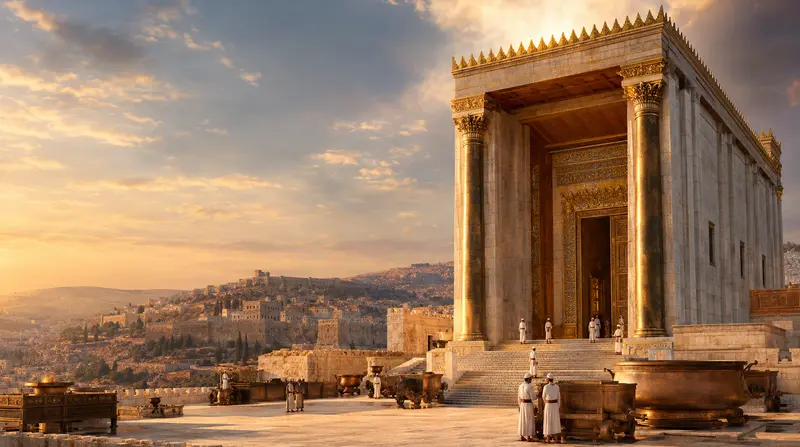
Modern illustrations of a floor plan or three-dimensional reconstruction combine the biblical description with evidence from comparable buildings and informed architectural judgment. Since the original sanctuary has not been archaeologically identified in a complete, verifiable form, these illustrations remain reconstructions rather than confirmed depictions of every historical detail.
Readers can examine the measurements and architectural sequence directly in 1 Kings 6 in the King James Version. The chapter provides the primary textual basis for discussing the building’s dimensions, interior spaces, and decoration.
The Porch, the Holy Place, and the Holy of Holies
The biblical description distinguishes several spaces within the sanctuary. At the entrance was a porch, called ulam in Hebrew. Beyond it lay the main hall, associated with the term heikhal, commonly described as the Holy Place. At the innermost end was the Holy of Holies, the most restricted sacred space in the building.
First Kings 6:16–20 describes the innermost chamber as a square room measuring twenty cubits on each side and twenty cubits in height. It was separated from the main hall and received special treatment in the account, including extensive gold covering. The description emphasizes the distinction between the principal sanctuary and its innermost room.
These spaces were not merely architectural conveniences. Their arrangement expressed a hierarchy of ritual access and differentiated the activities associated with different parts of the sanctuary. The most sacred area was not an unrestricted public room; access and service were governed by the religious organization of Israel.
The Hebrew word debir is associated with this innermost sanctuary, although the precise derivation and broader implications of the term should not be overstated. The safest approach is to interpret the word through its function in the architectural description rather than assign it an elaborate symbolic meaning unsupported by the passage.
Together, the porch, the main hall, and the innermost chamber create a sequence of spaces that can be compared with other ancient Levantine temples. These similarities help scholars evaluate plausible reconstructions, but they cannot settle every question about the building’s original design.
The Cherubim, Floral Decorations, and Jachin and Boaz Pillars
According to 1 Kings 6, the interior included carved representations of cherubim, palm trees, flowers, and other decorative motifs. These features covered parts of the walls and doors, creating an elaborate environment for the sanctuary’s sacred functions.
Cherubim should not automatically be imagined as the small, childlike angels common in modern artwork. In biblical literature, cherubim are heavenly beings associated with divine majesty and sacred space. Their representation in the temple belongs to that wider symbolic world, although the biblical description does not provide enough information to reconstruct every visual detail with certainty.
First Kings 7:15–22 describes two monumental bronze pillars named Jachin and Boaz. The account provides details about their height, capitals, and decoration, including lily-like forms and pomegranates. The text clearly treats them as distinctive architectural features, but it does not give a complete explanation of the theological meaning of every ornament.
Responsible interpretation therefore distinguishes the existence of a decorative element in the narrative from later symbolic explanations attributed to it. Readers may explore possible historical or religious associations, but such proposals should be identified as interpretations rather than presented as meanings explicitly supplied by Scripture.
The Bronze Altar, the Bronze Sea, and the Temple Furnishings in 1 Kings 7
The sanctuary complex included objects needed for priestly service, including an altar, large water vessels, stands, and other bronze furnishings. Their descriptions occupy a substantial portion of 1 Kings 7, demonstrating that the temple’s ritual equipment was an important part of the construction account.
The bronze sea was a particularly prominent feature. First Kings 7:23–26 describes an enormous circular vessel supported by twelve bronze oxen. It was associated with the water requirements of the temple service and formed one of the most distinctive objects in the courtyard.
The chapter also describes ten bronze stands equipped with basins. These objects belonged to the practical arrangements for ritual washing and preparation. The sanctuary’s operation involved organized procedures, priestly responsibilities, and prescribed practices, not merely the presentation of offerings.
Gold was prominent in the inner sanctuary and its furnishings, while bronze was used for large courtyard objects. These differences reflected the materials and craftsmanship assigned to various functions in the complex. The objects should therefore be understood in the context of Israelite worship rather than treated as decorative pieces without a ritual purpose.
What Was the Theological Significance of Solomon’s Temple?
The Ark of the Covenant and the Temple Dedication in 1 Kings 8
The Ark of the Covenant was central to the sanctuary’s symbolism. In 1 Kings 8:1–11, priests and Levites bring the ark into the innermost chamber during the dedication ceremony. The event involves the nation’s leaders and is presented as a collective religious occasion, not simply a private act by the king.
First Kings 8:9 states that the ark contained the two stone tablets associated with Moses and the exodus. This detail connects the newly dedicated sanctuary with the covenant history of Israel. The temple was not meant to replace that history; it stood within the story of a people who had been delivered from Egypt and bound to God by covenant.
After the priests leave the sanctuary, a cloud fills the building and prevents them from continuing their service. The account identifies this event with the manifestation of the Lord’s glory. The dedication is thus presented as more than the completion of an architectural project: it marks the building’s consecration for its religious purpose.
The ark’s placement also links the temple’s innermost space with the covenant’s central concerns. It is associated with God’s relationship with Israel, but it does not function as an object that confines or controls the divine presence. The prayer that follows makes that distinction explicit.
For the biblical narrative and its theological emphasis, consult 1 Kings 8, which describes the dedication and Solomon’s prayer. The chapter shows how the sacred furnishings, public ceremony, and royal prayer work together in the account’s interpretation of the sanctuary.
God’s Glory and the Difference Between Divine Presence and a Physical Building
One of the most important statements in Solomon’s prayer appears in 1 Kings 8:27. The king acknowledges that even the highest heavens cannot contain God, much less a building made by human hands. This is a decisive qualification: the Lord may be associated with the sanctuary without being physically confined to it.
The temple was a designated place for worship and prayer, but it could not restrict God’s activity. Solomon asks God to hear prayers associated with the sanctuary, including petitions offered by people who are far from Jerusalem. The prayer therefore combines the temple’s special function with an understanding of divine sovereignty that extends beyond its walls.
This distinction helps explain why the sanctuary could be both profoundly important and subject to prophetic criticism. Its sacred role did not mean that its possession guaranteed military victory, political continuity, or immunity from judgment.
For contemporary readers, the interpretive principle is straightforward: the significance of a religious institution must not be confused with the idea that God can be controlled by a location or a building. That conclusion comes from the biblical account itself, not from a later attempt to make the sanctuary irrelevant.
Solomon’s Prayer, the Covenant, and the Call to Faithfulness
The prayer in 1 Kings 8 addresses several situations in which Israel might need divine help: military defeat, drought, famine, sin, and the consequences of broken covenant obligations. Solomon asks God to hear the people when they pray toward the sanctuary and, where necessary, acknowledge their wrongdoing.
The prayer recognizes that the people can fail. The existence of the temple does not remove the possibility of disobedience, nor does it automatically resolve the consequences of injustice or idolatry. The repeated emphasis on hearing, forgiveness, and turning back to God shows that the relationship depends on more than the presence of a monumental building.
This theme appears earlier in the construction account. In 1 Kings 6:11–13, the promise associated with God’s dwelling among Israel is accompanied by a call to walk in the divine statutes and commandments. The narrative thus places the building within a moral and covenantal framework.
This is why the dedication should not be interpreted as an unconditional promise of national prosperity. Its theological logic combines divine promise with the responsibility of the people. The later history of Judah, including prophetic warnings and the loss of Jerusalem, develops the consequences of that relationship.
Sacrificial Worship and the Centralization of Worship in Jerusalem
The sanctuary also relates to the worship regulations in Deuteronomy 12, where Israel is instructed to worship the Lord at the place he chooses. These instructions stand in contrast to the religious practices associated with the surrounding nations and form part of the biblical movement toward a central sanctuary.
By making Jerusalem the location of the royal temple, the monarchy strengthened the city’s religious and political significance. Festivals, sacrifices, and priestly activities became closely associated with the capital. This arrangement also helps explain later debates about alternative sanctuaries and competing religious practices.
The historical development of Israelite religion was nevertheless complex. Biblical texts refer to other places of worship, and scholars continue to discuss how actual religious practice related to the prescriptions found in Deuteronomy. The biblical ideal of centralized worship should not be mistaken for proof that every Israelite community followed it uniformly in every period.
The central theological point is that worship in Jerusalem was meant to serve the covenant rather than replace it. The sanctuary organized the people’s religious life, but the building itself was not supposed to become an independent object of trust.
What Do the Biblical Texts Actually Say About the Temple—and What Do They Leave Uncertain?
Comparing the Accounts in 1 Kings 5–8 and 2 Chronicles 2–7
First Kings and 2 Chronicles both recount the construction and dedication, but they organize the material with different emphases. First Kings integrates the project into the broader narrative of Solomon’s reign, including the building’s dimensions, furnishings, dedication, and the later consequences of royal faithfulness or disobedience.
Second Chronicles 2–7 also describes the construction, workers, furnishings, and dedication. It places particular emphasis on public worship, priestly and Levitical service, Solomon’s prayer, and the divine response to the dedication.
These differences should not automatically be treated as contradictions, but neither should they be erased by pretending the two accounts are identical. Each book presents its material within its own literary and theological framework. A careful comparison asks what each account emphasizes, omits, or develops and how those decisions contribute to its purpose.
Chronicles, for example, gives particular attention to the organization of worship and the roles of the Levites. That emphasis is consistent with the book’s broader concern for Judah’s religious identity and continuity after periods of crisis. Recognizing these different priorities helps readers interpret both narratives more accurately.
The Meaning of the Hebrew Terms for the Temple’s Sacred Spaces
Several Hebrew terms help explain the building’s internal arrangement. Heikhal refers to a temple building or its principal hall, while debir is associated with the innermost sanctuary. Ulam designates the entrance porch.
These terms should not be treated as if each had a single, unchanging meaning in every biblical context. Their interpretation depends on the passage, the architectural description, and how each word relates to the surrounding spaces. Translation also requires care because a word that identifies a particular room in one passage may have a broader use elsewhere.
The terms nevertheless reveal that the building was not described as one undifferentiated room. The porch, main hall, and innermost chamber formed an ordered sequence that reflected the ritual organization of the sanctuary.
The Holy of Holies is especially important because it was associated with the Ark of the Covenant and the symbolism of divine presence. Its restricted access belonged to a religious system in which different people had different responsibilities and access to different spaces. The text’s architectural distinctions therefore carry both practical and theological significance.
The Literary Genre of Ancient Building Accounts and Their Theological Purpose
The biblical description includes dimensions, construction materials, skilled workers, inventories of objects, and a public dedication. These features resemble ancient royal building accounts, in which monumental projects could demonstrate a ruler’s resources, authority, and relationship with the divine.
This observation does not mean that the narrative should simply be dismissed as fiction. Nor does it mean that every detail should be treated as a modern technical report written by an eyewitness. The account is a biblical narrative shaped by theological concerns and transmitted within the literary history of Israel.
The building description does more than record the amount of timber or bronze used. It connects royal authority, worship, covenant obligations, and the dedication of a sacred space. The physical details contribute to the larger explanation of why the sanctuary mattered in Israel’s religious history.
Exegesis therefore considers both what the text describes and why it presents the description in that particular way. The question is not only how the building might have looked, but also how the account uses its architecture to express claims about Israel, the monarchy, and God.
Covenant Promises, Israel’s Unfaithfulness, and the Prophetic Critique of Empty Worship
Jeremiah 7 offers an important warning against treating the sanctuary as an automatic guarantee of protection. Addressing people who placed confidence in the temple, the prophet criticizes religious behavior that was contradicted by injustice, oppression, and disobedience.
Jeremiah’s argument does not require the conclusion that the temple had never been important. On the contrary, the warning has force precisely because the sanctuary held great significance for its audience. The problem was turning that significance into a form of religious security that supposedly made moral accountability unnecessary.
This criticism is consistent with Solomon’s prayer in 1 Kings 8, where sin, confession, and turning back to God are central concerns. A building could not serve as a magical protection against the consequences of covenant unfaithfulness.
The prophetic critique also helps explain the theological weight of the later destruction. The loss of the sanctuary was more than the defeat of an architectural monument. It became a crisis for Jerusalem’s political order, religious identity, and understanding of the covenant promises.
Did Solomon’s Temple Really Exist? What Can Archaeology Tell Us?
The Biblical Description as the Main Direct Literary Source
The main biblical descriptions of the first sanctuary are found in 1 Kings 6–7, with additional information in 2 Chronicles 3–4. These passages provide the primary literary evidence for its dimensions, materials, interior spaces, decoration, and furnishings.
No surviving structure has been conclusively identified as the original Jerusalem sanctuary in a way that allows archaeologists to verify every detail of the biblical account. The traditional temple location lies within the Temple Mount area of Jerusalem, where religious sensitivities and political restrictions make conventional archaeological investigation extremely limited.
Researchers therefore cannot compare a fully excavated structure with the measurements described in Kings. Instead, they examine the biblical texts alongside archaeological discoveries from other locations, the wider history of Jerusalem, and evidence for construction practices during the Iron Age.
This distinction matters. The Bible supplies a detailed account of a sanctuary associated with Solomon, while archaeology does not currently provide a complete, independently verified structure that establishes every dimension and furnishing in that account. The limits of the material evidence must be acknowledged without turning uncertainty into a claim that nothing can be known.
What Contemporary Temples in the Levant Reveal About Ancient Religious Architecture
Archaeological discoveries elsewhere in the ancient Levant reveal temples with features comparable to those described in the biblical narrative. Some have a sequence of spaces along a central axis, monumental entrances, columns, and decorative elements characteristic of ancient Near Eastern religious architecture.
The temples at Ain Dara in modern Syria and Tell Tayinat in southern Turkey are frequently discussed in scholarly comparisons. Their plans demonstrate that multi-part sanctuaries and certain architectural arrangements were known in the wider region during the Bronze and Iron Ages.
These parallels can help scholars assess whether the architectural description in Kings fits an ancient Levantine context. They also provide possible comparisons for interpreting the porch, main hall, innermost chamber, and surrounding structures.
However, similarity does not establish identity. A sanctuary at Ain Dara or Tell Tayinat is not the Jerusalem building, and shared architectural features can reflect regional traditions, cultural contact, or comparable solutions to religious needs. The discoveries support comparative analysis, not a direct identification of the original temple.
The Discoveries at Khirbet Qeiyafa and Motza and the Limits of Indirect Evidence
Khirbet Qeiyafa, an archaeological site in the Judean region, has attracted attention because of a small architectural model interpreted by some researchers as representing a sanctuary or monumental building. Its proposed early tenth-century BCE date is relevant to debates about the development of architecture in Judah during the period traditionally associated with the early monarchy.
The model is not the Jerusalem temple itself. Its value lies in providing evidence for architectural ideas and decorative traditions that may have been known in the region. How directly it should be connected to the account of Solomon’s building remains a matter of interpretation.
Motza, near Jerusalem, provides another important comparison. Archaeologists uncovered a religious building there dating to the Iron Age, commonly assigned to the ninth century BCE. The discovery demonstrates the presence of a substantial sanctuary in the region and offers material evidence for examining Judean religious architecture beyond Jerusalem.
Yosef Garfinkel and Madeleine Mumcuoglu discuss these discoveries and the history of research in their scholarly article The Temple of Solomon in Iron Age Context. Their study explores how archaeological comparisons contribute to interpreting 1 Kings while engaging the continuing debate about the historical setting of the description.
The crucial limitation remains: neither Khirbet Qeiyafa nor Motza proves who built the Jerusalem sanctuary, its precise date, or every detail in the biblical account. These discoveries enrich the historical context, but they are indirect evidence rather than the remains of the specific building under investigation.
Scholarly Debates About Dating, Historicity, and the Composition of the Biblical Account
The traditional chronology associates the construction with the tenth century BCE, during Solomon’s reign. This dating derives from the biblical chronology and broader reconstructions of the early monarchy. Scholars, however, differ over the extent of the kingdom at that time, the historical development of Jerusalem, and the relationship between the biblical narrative and the archaeological record.
Some researchers argue that the description preserves substantial information about an early temple, even if the text underwent later transmission and editing. Others emphasize the difficulty of independently confirming the scale of Solomon’s kingdom and question whether all the architectural details can be attributed to a single building phase.
There are also debates about when particular parts of the account reached their present form. A text can preserve older architectural knowledge while also reflecting the concerns of later writers and editors. Consequently, the date of an event described in a narrative and the date when that narrative was composed or revised are related but distinct historical questions.
Archaeological comparisons can strengthen some interpretations, but they do not resolve every uncertainty. The most careful conclusion recognizes the importance of the biblical testimony while distinguishing traditional chronology, plausible historical reconstruction, and independently demonstrated material evidence.
Why a Plausible Reconstruction Is Not the Same as Direct Archaeological Proof
A historical reconstruction brings together textual descriptions, comparative buildings, construction techniques, and informed assumptions to produce a plausible model of something that no longer survives. In this case, the biblical account provides much of the architectural information, while other Iron Age temples supply comparative evidence.
A modern illustration showing gold-covered walls, monumental pillars, and a carefully arranged courtyard is therefore not a photograph of the original structure. Some features may follow the biblical description closely, while others depend on decisions about uncertain dimensions, roofing, elevations, and surrounding spaces.
The same caution applies to reports of discoveries. Finding a sanctuary from approximately the same period does not establish that it was the Jerusalem temple. Discovering an architectural tradition in Judah does not, by itself, determine the precise history of every building associated with the monarchy.
These distinctions do not make archaeological research irrelevant. They allow readers to understand what the evidence supports and where interpretation begins. A strong historical argument identifies its sources, explains its assumptions, and avoids claiming more certainty than the available evidence warrants.
How and Why Was Solomon’s Temple Destroyed?
The Crisis of the Kingdom of Judah and the Babylonian Conquest of Jerusalem
After the united monarchy divided, Jerusalem remained the capital of the southern kingdom of Judah. The sanctuary continued to play an important role in religious life, while Judah experienced political instability, changes in royal leadership, military pressures, and debates over religious reform.
During the late seventh and early sixth centuries BCE, the Neo-Babylonian Empire became the dominant power in the region following the decline of Assyria. Judah became caught in the struggle between regional powers and faced increasing pressure from Babylon.
During the reign of Zedekiah, Judah rebelled against Babylonian control. Nebuchadnezzar II responded with a military campaign that culminated in the siege and capture of Jerusalem. The biblical narratives in 2 Kings 24–25 and related passages in Jeremiah describe the political crisis and its consequences.
The conquest can be understood as a geopolitical event involving imperial expansion and a local rebellion. The biblical writers also interpret it through the theology of the covenant, connecting Judah’s disaster with the prophetic warnings about idolatry, injustice, and persistent disobedience.
The Destruction of the First Temple and the Babylonian Exile
According to 2 Kings 25:8–17, Babylonian forces burned the temple, the royal palace, and important houses in Jerusalem. The city’s defenses were damaged, and many inhabitants were deported. Bronze vessels and other sacred objects were removed or broken, according to the inventory in the narrative.
The destruction of Jerusalem is conventionally dated to 586 BCE, although some chronological reconstructions use 587 BCE. The event marked a profound break in Judah’s history because the capital, the royal establishment, and the central sanctuary were affected together.
For the exiles, the loss of the sanctuary raised difficult theological questions. How could the promises associated with Jerusalem be understood after the city had fallen? What would become of Israel’s identity without its principal place of worship? Biblical literature from and after the exile responds to these questions in different ways, acknowledging the catastrophe while preserving hope for restoration.
The loss of the building did not mean, within the biblical theological framework, that God had ceased to exist or could no longer act outside Judah. Prophetic writings emphasize that divine sovereignty extends beyond the boundaries of a nation and is not dependent on the survival of a single sanctuary.
The account of the final conquest and the removal of sacred objects can be read in 2 Kings 25 in the King James Version. This narrative is essential for understanding the destruction of Jerusalem within the broader history of Judah and the Babylonian exile.
The Differences Between the First Temple, the Second Temple, and Herod’s Expansion
The First Temple is the sanctuary associated with Solomon and destroyed by the Babylonians. After the return of some exiles, a new temple was constructed under leaders associated with Zerubbabel and the restoration community. The rebuilding account appears in Ezra 1–6, and the completed structure became known as the Second Temple.
The Second Temple did not remain unchanged throughout its existence. Centuries later, Herod the Great undertook an extensive renovation and expansion of the Jerusalem complex. His project transformed the site’s scale and appearance, producing the monumental sanctuary associated with the period of Jesus and the New Testament narratives.
These structures belong to different historical periods and should not be treated as interchangeable. The First Temple belongs to the monarchy of Judah; the Second Temple belongs to the postexilic community and the periods that followed; and the Herodian expansion reflects the political and architectural setting of the Roman era.
This distinction is essential when reading the Gospels. References to the temple during Jesus’ ministry concern the complex that existed centuries after the destruction of the earlier sanctuary. Details from that later building cannot automatically be projected onto the original structure described in Kings.
What Does Solomon’s Temple Mean in Christian Interpretation?
The Temple and Sanctuary Imagery in the New Testament
The New Testament uses temple and sanctuary imagery to explain the identity of Jesus, the significance of his death and resurrection, and the relationship between the old covenant and Christian faith. These theological interpretations should be distinguished from the original historical function of the Jerusalem sanctuary.
In the Hebrew Bible, the temple was a physical building with priestly responsibilities, sacrifices, sacred furnishings, and designated spaces. In the New Testament, sanctuary language can also function figuratively, expressing theological claims about Jesus and access to God. Such interpretations do not erase the temple’s historical role; they develop its imagery within a different literary and theological setting.
This distinction helps avoid a common interpretive mistake: assuming that every measurement, decoration, or object in the earlier sanctuary must have been intended as a direct prediction of a later Christian doctrine. A sound reading begins with the original passage and then examines how New Testament writers use or reinterpret the tradition.
John 2:19–21 and the Christian Interpretation of Jesus as the Temple
In John 2:19–21, Jesus speaks of destroying the temple and raising it in three days. The Gospel writer explains that Jesus was referring to the temple of his body. The statement occurs in the context of Jesus’ intervention in the temple precincts and becomes a reference to his death and resurrection.
The narrator’s explanation is decisive for understanding the passage. Although the saying initially sounds like a statement about the Jerusalem building, the Gospel directs readers toward Jesus’ body. Its significance lies in the relationship between the temple imagery and the resurrection, not in a prediction that the original sanctuary would be physically rebuilt after three days.
For Christian interpretation, the passage presents Jesus as the decisive point of reference for the temple’s theological significance. This does not retroactively change the historical function of the earlier sanctuary. It shows how the Gospel interprets sacred-space imagery in light of its claims about Jesus’ identity and mission.
Acts 7:47–50 and the Limits of Confining God to a Building
In Acts 7, Stephen recounts key episodes in Israel’s history while addressing the authorities who have brought accusations against him. When he turns to the temple, he invokes the prophetic tradition that the Most High does not dwell in houses made by human hands.
Stephen’s argument is not simply that all places of worship are wrong. He challenges the assumption that God can be confined to a building or that possession of a sacred institution guarantees faithfulness. The criticism is especially pointed because the sanctuary was central to Jewish religious identity.
This theme has a clear connection with Solomon’s prayer in 1 Kings 8, which acknowledges that the heavens themselves cannot contain God. Acts develops a related theological point by questioning any attempt to make a physical sanctuary the measure or boundary of divine action.
The temple can therefore retain its historical and religious importance without being treated as greater than the God to whom it was dedicated. The theological issue is not whether a sanctuary once mattered, but whether human beings mistakenly treat it as a substitute for genuine faithfulness.
Hebrews 9 and the Christian Interpretation of the Sanctuary and Sacrifice
Hebrews 9 examines the sanctuary’s arrangement, sacred objects, and sacrificial practices in connection with the old covenant. The author uses this material to develop an argument about Christ’s priestly work and the significance of his offering.
The chapter contrasts the earthly sanctuary with a heavenly reality and argues that the earlier ritual system must be understood in relation to the work of Christ. Its purpose is theological rather than archaeological: it does not attempt to provide a complete architectural reconstruction of the first Jerusalem temple.
Nor does Hebrews describe only the building associated with Solomon. Its argument draws more broadly on the biblical traditions of sanctuary and priesthood, including the ritual system associated with the tabernacle. These distinctions matter because the book’s theological claims depend on the relationship between the older covenantal arrangements and its understanding of Jesus.
Christian readers can therefore recognize the sanctuary as a key part of the author’s argument without assuming that every object in the building represents an independent spiritual lesson. The interpretation should follow the passage’s actual reasoning about priesthood, sacrifice, purification, and access to God.
Distinguishing the Original Historical Meaning from Later Theological Readings
One of the central tasks of biblical interpretation is to distinguish what a passage communicated in its original setting from how later biblical writers use its themes. In this case, the first step is to understand the sanctuary within Israel’s monarchy, covenant traditions, sacrificial worship, and historical experience.
The next step is to examine how New Testament authors draw on temple imagery to explain Jesus, the resurrection, and the relationship between God and his people. These later readings are significant within Christian theology, but they should not be confused with the immediate purpose of every architectural detail in 1 Kings.
For example, a Christian may understand Hebrews as presenting a theological interpretation of sanctuary and sacrifice without claiming that the writer of Kings consciously intended every argument later developed in Hebrews. This approach respects both the historical context of the earlier text and the theological connections made across the biblical canon.
It also guards against overly symbolic interpretations. Not every column, measurement, or decorative motif necessarily communicates a separate spiritual message. Responsible application begins by establishing what the text says and then considers how its central theological claims can inform Christian understanding today.
Conclusion: What Can We Safely Conclude About Solomon’s Temple?
Summarizing the Biblical, Historical, and Archaeological Evidence
The accounts in 1 Kings and 2 Chronicles present the sanctuary as a central institution in Israel’s religious life, connected to the Davidic monarchy, the Ark of the Covenant, and the dedication of a permanent place of worship. They provide detailed descriptions of its dimensions, materials, sacred spaces, furnishings, and ritual functions.
Those same accounts insist that God cannot be contained by a human-made structure. Solomon’s prayer, together with later prophetic criticism, shows that the sanctuary did not remove the people’s responsibility to observe the covenant or guarantee protection regardless of their conduct.
Historically, the First Temple was destroyed during the Babylonian conquest of Jerusalem, a catastrophe connected with the exile and a profound transformation of Judah’s identity. The later Second Temple and the Herodian expansion belong to different historical periods and must be distinguished from the original building.
Archaeological parallels from the Iron Age Levant help scholars understand the architectural setting, but they do not directly verify every detail of the Jerusalem sanctuary. The most careful assessment takes the biblical testimony seriously, examines the material evidence, and distinguishes established information from historical hypotheses that remain debated.
Frequently Asked Questions
What was Solomon’s Temple, and what was it used for?
It was the sanctuary built in Jerusalem during Solomon’s reign, according to 1 Kings 5–8 and 2 Chronicles 2–7. It served as a central place for Israelite worship, housing the Ark of the Covenant in its innermost chamber and supporting priestly service, sacrifices, offerings, and religious festivals. It symbolized God’s relationship with Israel without implying that God was physically limited to the building.
Who built Solomon’s Temple, and how long did it take?
According to 1 Kings 6:1 and 6:38, Solomon began the project in the fourth year of his reign, and the main building was completed in seven years, during his eleventh year. David had previously expressed the desire to build a sanctuary and prepared resources for the project, but Solomon is credited with carrying out the construction. The biblical account also describes the contribution of workers and specialists connected with Hiram, king of Tyre.
Where was Solomon’s Temple located, and what were its dimensions?
The temple was located in Jerusalem. Second Chronicles 3:1 associates its construction with Mount Moriah and the site of the threshing floor of Ornan. First Kings 6:2 gives the main building’s dimensions as sixty cubits long, twenty cubits wide, and thirty cubits high. Using an approximate cubit of eighteen inches, these measurements equal about ninety by thirty feet, with a height of forty-five feet. These are approximate conversions and do not represent the total area of the surrounding complex.
What was inside Solomon’s Temple?
The building included an entrance porch, a main hall, and the Holy of Holies. The interior was decorated with gold, carved cherubim, and plant motifs. The Ark of the Covenant was placed in the innermost chamber during the dedication. The wider complex also included a bronze altar, the bronze sea, basins, stands, and other objects used in priestly service. These furnishings had ritual and symbolic functions, not merely decorative ones.
Did Solomon’s Temple really exist, and what does archaeology prove?
The Bible provides a detailed description of the sanctuary, but no complete set of archaeological remains has been conclusively identified as the original building in Jerusalem. Discoveries at Motza and Khirbet Qeiyafa help researchers understand religious architecture in the region during the Iron Age, but they do not directly prove the construction attributed to Solomon. The dating of the building, the scale of the early monarchy, and the relationship between the biblical account and the archaeological record remain subjects of scholarly debate.
Who destroyed Solomon’s Temple, and what happened afterward?
The Babylonians destroyed the First Temple during the conquest of Jerusalem, conventionally dated to 586 BCE, although some chronologies use 587 BCE. The campaign took place under Nebuchadnezzar II and involved the destruction of parts of the city and the deportation of inhabitants. After the exile, returning Judeans rebuilt the sanctuary, creating the Second Temple. Centuries later, Herod the Great extensively expanded that complex, which is the temple associated with the setting of the New Testament Gospels.
Continue exploring biblical history and interpretation with The Ten Commandments: Meaning, Biblical Context, and Interpretation and The Lord’s Prayer: Full Text, Meaning, and How to Live Its Teachings. Both articles offer further opportunities to study the biblical context of covenant, worship, and prayer on Agapath.